
Soy Baby Wipes
Clip: 6/22/2026 | 6m 5sVideo has Closed Captions
See how college students are turning soybeans into new products like baby wipes.
See how college students are turning soybeans into new products like baby wipes.
Problems playing video? | Closed Captioning Feedback
Problems playing video? | Closed Captioning Feedback
America's Heartland is presented by your local public television station.
Funding for America’s Heartland is provided by US Soy, Sustainable Agriculture Research and Education, Rural Development Partners, and a Specialty Crop Grant from the California Department of Food and Agriculture.
Soy Baby Wipes
Clip: 6/22/2026 | 6m 5sVideo has Closed Captions
See how college students are turning soybeans into new products like baby wipes.
Problems playing video? | Closed Captioning Feedback
Where to Watch America's Heartland
America's Heartland is available to stream on pbs.org and the PBS app.
Providing Support for PBS.org
Learn Moreabout PBS online sponsorship- There's a good chance you've heard of soy candles and soy crayons.
They've been on the market for decades.
But what may surprise you, they got their start here at Purdue University as part of a student competition that's been going on for more than 30 years.
It's called the Student Soybean Innovation Competition.
And the winners not only come away with a cash prize, but often a viable product they can patent and potentially take to market.
- How they come up with it, I have no idea.
But it's impressive to me to see the young minds at work, to see how they develop those products, to be able to produce that in a way that they can use that as a marketable business opportunity.
- Kevin Cox is a soybean farmer and past chairman of the Indiana Soybean Alliance.
The alliance partners with Purdue to support the student competition.
That's because for farmers like Kevin, every new soy-based product opens up new opportunities to enhance the value of their product.
- So as a producer, anytime we can come up with something that uses more of our soybeans, especially for me as an Indiana producer, I want to do all that I can to make sure that, you know, I'm producing a crop in a way that it's gonna be here for future generations.
- Back at Purdue University, students who enter the competition must first overcome a tough hurdle.
Finding a new idea.
- We realize that coming up with a totally novel and new idea is hard.
There will be many failures.
- Professor Nate Mosier remembers a team in 2011 that pitched more than 130 ideas.
They landed on a soy-based denture cream called Dentural.
It went on to win top prize that year.
- We are very intentional that we recruit students at Purdue University from any background, any major.
A common comment I hear from students is, "I've never seen a soybean in my life, but I really don't know anything about them, what they can be used for or anything."
And so we connect the students not only with experts on the faculty here at Purdue, but with companies like Cargill and ADM that process soybeans and make the soybeans into a wide variety of useful products.
- Students in the competition receive this soy sample kit filled with lab equipment, raw soy material like soy protein, flour, and wax.
- So they're using the real products that are available to manufacturers today to make the products that are made from soybeans.
Did it take a lot of different combinations for you to figure out?
- Yeah, so we actually use both of these kind of blend with different ratio.
We test both of them out.
- Kyle Han is a biological engineering student at Purdue.
For the 2024 competition, he paired up with business student Ben Gottlieb.
- We knew from day one that we were gonna go out and try and win.
- Kyle and Ben came up with an idea for soy-based baby wipes, traditional baby wipes contained plastic and we're soon to be banned in the United Kingdom.
- And that's how I thought maybe soybean can help.
And then I put my head into it and how, like, we work on it and we created SoySilk.
- I remember the first day we were in there just like with some of our raw materials, just like by hand, stacking them together.
And it gave me just a different perspective on how products really come to market.
- They called their baby wipe SoySilk.
It uses soy fiber for the base sheet and the moisturizing agents are soy-based as well.
- So, basically, the entire product from the start to finish, we have soybean incorporated in it.
- So this is our really first prototype that's handmade here.
We have... It's made out of the soy fiber, and then we have different like wetting agents on it to make it clean.
And I remember the first time Kyle sent me the video of the working prototype.
And being able to see it outcompete the best sustainable baby wipe on the market was shocking.
- The best products, and usually the ones that win, not only work well, they outperform the competition.
So they're renewable, they're biodegradable in many cases, but they work as well or better than their competitors on the market.
- Over $100 million of damage every year to plumbing systems comes from baby wipes and the plastic polymers that aren't able to break down, causing, like, blockages and sewage.
Which is why in the UK, there were proposed laws to ban them.
- Ben and Kyle see SoySilk as a way to fill that void in the market.
But first, the competition.
- We were able to showcase our product, which was super rewarding to see people impressed with what we came up with.
- We performed better than other baby wipes on the market.
- We were not sure if we were gonna win.
We were kind of stressing out a little bit.
- When they announced third place, like, "Okay, that's not my name."
Second place, "That is not my name."
And we're like, "Okay, maybe we we're not winning this year."
And then when they announced, "First place is SoySilk," like I remember me and Ben, we just looked at each other.
We're like, "Is that true?"
- For the grand prize, Team SoySilk.
- It was true.
They won first place and a $20,000 grand prize.
But their journey isn't over.
Like winners before them, they hope to see their product someday be realized.
- We work hard to make sure technologies that can be patented are.
it's very difficult to launch a new product.
The success stories have been ones where things have been developed to a point where a company was interested enough of taking that next step, that next leap to take the product to market.
- My goal is to hopefully partner or license this technology to a bigger company that has more of the backing to put this in stores and get it out to market.
- And every year, soybean farmers like Kevin look forward to seeing what creative new ideas students come up with.
- So, as a soybean producer, big deal.
What do I care?
Once it goes on the truck, it goes to the elevator.
But to be able to see new products being able to be developed each year, it's exciting for me as a producer to be able to know that I've got a hand in some of that.
 New
NewVideo has Closed Captions
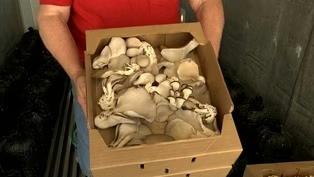
A California farmer shares easy-to-grow mushrooms with giftable box kits. (5m 43s)
 New
NewVideo has Closed Captions
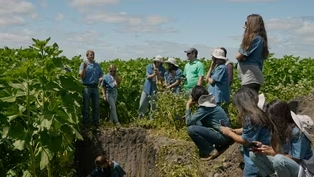
A Minnesota farm family plants a new kind of wheat that restores the soil and saves water. (5m 2s)
 New
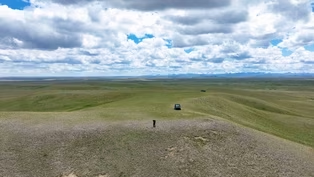
NewMontana Grasslands Restoration
Video has Closed Captions
A Montana rancher honors his ancestors, and Mother Earth, by restoring native grasses to his land. (5m 33s)
Providing Support for PBS.org
Learn Moreabout PBS online sponsorship
- Food
Christopher Kimball’s Milk Street Television
Transform home cooking with the editors of Christopher Kimball’s Milk Street Magazine.





Support for PBS provided by:
America's Heartland is presented by your local public television station.
Funding for America’s Heartland is provided by US Soy, Sustainable Agriculture Research and Education, Rural Development Partners, and a Specialty Crop Grant from the California Department of Food and Agriculture.