
Montana Grasslands Restoration
Clip: 6/22/2026 | 5m 33sVideo has Closed Captions
A Montana rancher honors his ancestors, and Mother Earth, by restoring native grasses to his land.
A Montana rancher who is part of the Blackfeet tribe honors his ancestors, and Mother Earth, by restoring native grasses to his land.
Problems playing video? | Closed Captioning Feedback
Problems playing video? | Closed Captioning Feedback
America's Heartland is presented by your local public television station.
Funding for America’s Heartland is provided by US Soy, Sustainable Agriculture Research and Education, Rural Development Partners, and a Specialty Crop Grant from the California Department of Food and Agriculture.
Montana Grasslands Restoration
Clip: 6/22/2026 | 5m 33sVideo has Closed Captions
A Montana rancher who is part of the Blackfeet tribe honors his ancestors, and Mother Earth, by restoring native grasses to his land.
Problems playing video? | Closed Captioning Feedback
Where to Watch America's Heartland
America's Heartland is available to stream on pbs.org and the PBS app.
Providing Support for PBS.org
Learn Moreabout PBS online sponsorship- So the way I visualize myself as a steward of this land, and that's the proper word, not owner, not manager, but steward.
- The beautiful grasslands you see here didn't always look like this.
Since the 1990s, Joe Kipp, a rancher and member of the Blackfeet Nation, and his wife Kathy, have been working tirelessly to restore this land, not just for their livelihood, but for generations to come.
- [Joe] This is where my people have been since the beginning of creation.
This is our treaty lands, what was given to us by creator and by treaty.
This is who I am.
- This land was passed down to Joe by his late father-in-law.
When he stepped in, there were some major issues.
- It really was not the system you see today.
It would've been heavily overgrazed by trespass cattle, no water resources, no fencing.
The grass species were really non-palatable, non-nutritional types.
And we started doing our conservation efforts basically 35 years ago with the idea to get rough fescue reestablished in our fields.
It's one of the most wonderful, nutritious plants on Mother Earth for ruminants.
- To help return the more nutritional native prairie grasses to the landscape, Joe sought some help from the Natural Resources Conservation Service or NRCS.
- We went and explained our situation to 'em.
They were very gracious, very helpful.
They got the okay from the fed, the DC level.
And so they did help us.
We built this boundary fence right here.
We went around most of the acreage we owned, and then we said, "Okay, what can we do for cross-fencing?"
- Different from boundary fencing, which separates properties, cross-fencing helps divide up the land for management, creating smaller pastures and providing more control of when and where your cattle graze.
- We had fencing projects funded by the NRCS for about 18 years straight, and then we started the water developments.
And so we could start putting water in each unit, sustainable water, so that we could rotationally graze the cattle and move them.
Intensely graze for very short period of time, and then go to the next field, and then let that rest for the entire rest of the season up until next year.
- For Joe, it's important to be drought resistant to avoid having to sell and purchase new cattle, which could bring in outside diseases and pathogens.
He does so by ensuring that there's always some old growth in the field to get through the drier years.
- If you got 1,000 acres and 200 cows and you just put 'em all in there, they're gonna go to the very most nutritious, most palatable grass species.
They're gonna kill those off by overgrazing them and you're not forcing 'em to graze the rough forage.
But if you cut that field into four, four different pastures by two different fences, and, say, you got a four month-grazing season, move them one month in each unit, but you graze everything, even the undesirable plants they don't want to eat, but you graze it, and then you move.
So all the plants, they're all competing fairly against one another.
- Once the right fencing was put up, Joe had another challenge to tackle.
- There's no groundwater, or at least no drillable groundwater.
We have a few old springs, but in a dry part of the year, it'll only flow about a hundred yards down and then it soaks back into the ground.
There's enough water in there.
That flows about three gallons a minute.
200 cows is gonna need 4,000 gallons of water per day.
- Providing enough water is not the only challenge.
Having water in tanks ensures it's clean and free of parasites that might otherwise be passed along from cattle waste.
- It's coming outta Mother Earth nice and clean.
And when the calves drink it, they're not gonna get full of worms or germs.
And so that's what we wanted to do.
We started setting up isolated tanks.
- To raise cattle sustainably, Joe engages in another sustainable practice, the use of solar energy.
- If you look around the horizon here, you don't see one power line.
Basically, out here, to distribute the water, I probably rely 90% on solar power to pressurize that line that distribute the water to the cattle.
- After years of restoration, diverse wildlife has also returned to this sacred land.
- [Joe] There's lots of sharp-tails, there's lots of antelope.
- Like Joe, other ranchers in Northern Montana have learned restoration practices from the NRCS.
The return of more native prairie grasslands is helping to provide healthy feed to both cattle and domestic bison herds, both important sources of revenue.
- My message to my people and to the world would be, to really do these practices properly.
You're fencing, cross-fencing, water distribution, rotational grazing.
You're not gonna fix it in one year.
It may take decades to get where you wanna go, but you're never gonna get there if you don't start.
The land's gonna survive me.
It's gonna go... I'll be gone.
I'll be part of the land, and it'll still be producing.
 New
NewVideo has Closed Captions
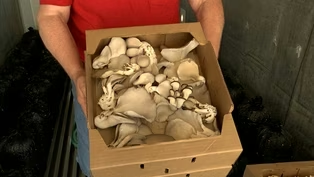
A California farmer shares easy-to-grow mushrooms with giftable box kits. (5m 43s)
 New
NewVideo has Closed Captions
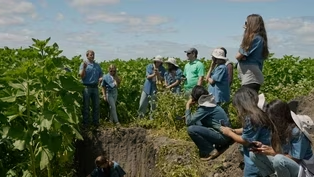
A Minnesota farm family plants a new kind of wheat that restores the soil and saves water. (5m 2s)
 New
NewVideo has Closed Captions
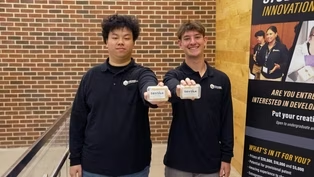
See how college students are turning soybeans into new products like baby wipes. (6m 5s)
Providing Support for PBS.org
Learn Moreabout PBS online sponsorship
- Food
Christopher Kimball’s Milk Street Television
Transform home cooking with the editors of Christopher Kimball’s Milk Street Magazine.






Support for PBS provided by:
America's Heartland is presented by your local public television station.
Funding for America’s Heartland is provided by US Soy, Sustainable Agriculture Research and Education, Rural Development Partners, and a Specialty Crop Grant from the California Department of Food and Agriculture.