
July 28, 2026 - PBS News Hour full episode
7/28/2026 | 57m 46sVideo has Closed Captions
July 28, 2026 - PBS News Hour full episode
July 28, 2026 - PBS News Hour full episode
Problems playing video? | Closed Captioning Feedback
Problems playing video? | Closed Captioning Feedback
Major corporate funding for the PBS News Hour is provided by BDO, BNSF, Consumer Cellular, American Cruise Lines, and Raymond James. Funding for the PBS NewsHour Weekend is provided by...
July 28, 2026 - PBS News Hour full episode
7/28/2026 | 57m 46sVideo has Closed Captions
July 28, 2026 - PBS News Hour full episode
Problems playing video? | Closed Captioning Feedback
Where to Watch PBS News Hour
PBS News Hour is available to stream on pbs.org and the PBS app.
Providing Support for PBS.org
Learn Moreabout PBS online sponsorshipGEOFF BENNETT: Good evening.
I'm Geoff Bennett.
AMNA NAWAZ: And I'm Amna Nawaz.
On the "NewsHour" tonight: two White House visits, two different wars.
What Ukraine's president and Israel's prime minister are hoping to accomplish with their trips to the U.S.
GEOFF BENNETT: Politicians and family members pay tribute to the late South Carolina Senator Lindsey Graham at Washington's National Cathedral.
AMNA NAWAZ: And new research shows abortion bans worsening medical care during miscarriages and creating challenges for doctors.
DR.
ALECIA FIELDS, OB-GYN: It really is difficult to sit back and feel like your hands are tied and that you can't help them.
You can support them, but you can't do anything for them.
(BREAK) AMNA NAWAZ: Welcome to the "News Hour."
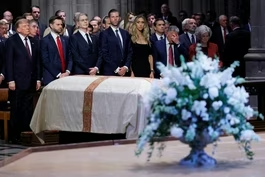
Today, the late Senator Lindsey Graham was remembered as a tireless fighter for South Carolina and an influential fixture on the world stage during a memorial service at the Washington National Cathedral.
GEOFF BENNETT: President Trump eulogized Graham after hosting two of Graham's strongest international allies, Israel's prime minister and Ukraine's president.
Nick Schifrin starts our coverage.
NICK SCHIFRIN: Today, it was all smiles in the Oval Office and a tale of two leaders, a U.S.
partner once disparaged now praised, and a wartime ally once celebrated now increasingly doubted.
For years, President Trump has stood by Israeli Prime Minister Benjamin Netanyahu's side with repeated endorsements.
DONALD TRUMP, President of the United States: There's only one Prime Minister Benjamin Netanyahu.
Bibi, please stand up.
NICK SCHIFRIN: Crescendoing in an unprecedented joint war.
DONALD TRUMP: We have a little difference, but pretty close.
NICK SCHIFRIN: But, recently, President Trump has acknowledged a gap between Israel's pushing for an indefinite occupation of Southern Lebanon... DONALD TRUMP: I was a little bit perturbed at his constantly fighting with Lebanon.
At some point, I said, Bibi, we got to step this.
NICK SCHIFRIN: ... and a gap between President Trump's desire to make a deal with Iran and some Israelis pushing for escalation, even publicly discussing bombing Iran's Pickaxe Mountain, which Israel says hides Iranian nuclear enrichment devices.
DONALD TRUMP: I don't need Bibi to tell me that.
Bibi's telling me that because he wants me to stay involved.
I heard Bibi announce that.
I said, why don't you just tell it to me?
Why do you have to announce it to the world?
NICK SCHIFRIN: And the war in Gaza has made support for Israel more partisan.
ZOHRAN MAMDANI (D), Mayor of New York City: Benjamin Netanyahu is a war criminal.
NICK SCHIFRIN: New York City Mayor Zohran Mamdani has disparaged Netanyahu and endorse Democratic candidates critical of Israel, all of whom won their primaries.
J.D.
VANCE, Vice President of the United States: Anybody in Israel who thinks their biggest problem is the president of the United States needs to wake up and smell the reality of the situation that country is in.
NICK SCHIFRIN: The criticism is increasingly bipartisan and voiced this month on Joe Rogan's podcast by Vice President Vance.
J.D.
VANCE: There are some people within their system we know beyond a shadow of a doubt who are manipulating and trying to change American public opinion to keep the war going on indefinitely, again, not towards any objective, but just indefinitely.
NICK SCHIFRIN: But, this afternoon, Netanyahu called today's meeting excellent.
BENJAMIN NETANYAHU, Israeli Prime Minister (through translator): It was a conversation of full partnership, of mutual support, an understanding of the shared goal to ensure that Iran will not have nuclear weapons and also other goals.
NICK SCHIFRIN: As for Zelenskyy: DONALD TRUMP: He's done an amazing job.
Look, he's been -- he's been very effective.
He's had the best equipment because he's had our equipment.
NICK SCHIFRIN: President Trump and other senior officials have recently provided him praise.
DONALD TRUMP: We have actually developed a good relationship.
It's hard to believe, right?
From the Oval Office to now.
NICK SCHIFRIN: It's light years from last year's train wreck... DONALD TRUMP: You're gambling with World War III.
NICK SCHIFRIN: ... and demands to end the war, no matter the cost to Ukraine.
DONALD TRUMP: They should stop right now at the battle lines,go home, stop killing people and be done.
NICK SCHIFRIN: But Ukraine has recently seized the frontline initiative, launching strikes deep into Russia and cutting off Russian supplies to occupy Crimea.
And, tonight, Ukrainian officials tell "PBS News Hour" the meeting was -- quote -- "very practical" and focused on restarting diplomacy, including a possible visit by presidential envoys Steve Witkoff and Jared Kushner to Ukraine.
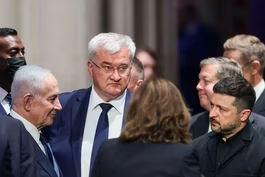
Zelenskyy and Netanyahu came together briefly before Senator Graham's memorial, two leaders of two countries whom Graham championed.
SEAN HANNITY, FOX News Anchor: He loved the state of Israel.
He loved the people of Israel.
NICK SCHIFRIN: And as FOX News' Sean Hannity noted to a full Washington National Cathedral, Graham's final trip was to Kyiv to visit Zelenskyy and push a new sanctions package on Russia, expected to pass in the coming days.
SEAN HANNITY: Your country has shown a fighting spirit that no one ever predicted.
Now, he was proud of you and the courage of your countrymen.
NICK SCHIFRIN: A sentiment that President Trump has come to appreciate, even as he acknowledges gaps with a wartime ally.
For the "PBS News Hour," I'm Nick Schifrin.
GEOFF BENNETT: Senator Graham's memorial today brought together presidents, prime ministers, senators, and Cabinet officials.
The day started at the Rotunda at the U.S.
Capitol, where the late congressman and senator served for 30 years and became known as a foreign policy hawk, a key presence on the Senate Judiciary Committee, and ultimately a strong ally of President Trump.
President Trump and Graham's niece remembered him during today's funeral service.
DONALD TRUMP, President of the United States: By the strength of his steadfast convictions, the force of his magnetic personality and the goodness of his noble soul, Lindsey rose from a small town in rural South Carolina, a place he loves so much, to become a constant fixture of American politics at the highest level, and a force to be reckoned with all over the world.
EMILLIE BOGGS ROBERTS, Niece of Lindsey Graham: Lindsey was without a doubt a family man.
His world revolved around my mother, his family, and those he considered such, like his lifelong friends, colleagues, staff, and the citizens of South Carolina.
GEOFF BENNETT: Gavin Jackson from public media station South Carolina ETV was at the funeral service today and joins us from outside the National Cathedral.
Gavin, thank you for being with us.
So, take us inside the cathedral.
What struck you the most about the service today?
GAVIN JACKSON, South Carolina ETV: Yes, Geoff, I think what struck me the most about the service today was maybe what folks couldn't see at home or what was happening before the service even started, when you had, like you were saying, these international dignitaries there, including Ukrainian president Volodymyr Zelenskyy, as well as Prime Minister of Israel Benjamin Netanyahu.
They were mingling.
They were talking.
I know that happens at a lot of these major events in Washington too, but it was almost fitting for the late Senator Lindsey Graham to essentially host an international confab as his last going away memorial, in a sense, as part of this day one of day two, two-part day series of him being remembered not just here in Washington, but back home in South Carolina tomorrow.
So to have folks from back home in South Carolina -- I saw the Senate majority leader, Shane Massey, there back home in South Carolina, to these international figures.
It was very fascinating to see that contrast, and then also to hear from the president, who, of course, Trump and Graham have both had a very fascinating friendship over the years.
Anyone knows that, especially when they both ran for president back in 2016.
And he referenced that in his remarks too.
One of the funnier moments during that eulogy for the president talking about how he gave away the senator's number, his personal cell phone number that he had for 20-some years on the campaign trail during this heated times.
And he had to change that phone number, but then, of course, moving forward the two became close friends, and he said Lindsey had kept calling me for the past 10 years now.
So I think it was a bit of a lighthearted moment, and I think Senator Graham would have appreciated not just all the dignitaries there that he's worked with over the years, but also just the lighthearted nature of today's service.
He probably could have enjoyed a few more jokes at his own expense, though.
GEOFF BENNETT: You covered Senator Graham for years.
How do you reconcile the arcs from John McCain's wingman to Donald Trump's harshest critic, ultimately, as we know, to Donald Trump's strongest ally in the U.S.
Senate?
Which was the real Lindsey Graham?
GAVIN JACKSON: Well, I think the real Lindsey Graham was the one that kept fighting for South Carolina and delivering for South Carolina.
These other parts of his career were tangential to that because he wanted to get things done.
And in order to get things done, he had to adapt.
A lot of people talk about that he didn't -- maybe wasn't strong enough after January 6, despite his words on the Senate floor.
And he came back around to working closely with President Trump going forward to get him reelected, being his top cheerleader.
So, in doing that, he got to advance not only his agenda for South Carolina, but also his agenda for the nation, as well as the international stage.
Of course, national security was a huge factor for Senator Graham, and he wanted to see that take place.
He wanted to push his agenda.
We're seeing that play out right now with what happened in the Middle East, of course, with what's going on in Iran.
And that's what actually counted for Lindsey Graham to advance that agenda, to get the right people in place to pay attention to his world view and to push his foreign policy.
Yes, it was much different than the days of John McCain and Lieberman, of course, the Three Amigos there too, but he had to adapt.
This party has changed.
His party has changed.
In order to be relevant in this party, he had to change as well.
GEOFF BENNETT: Darline Graham was there today mourning the brother who raised her.
She now occupies his former Senate seat.
That special primary in South Carolina is two weeks away.
What does the campaign look like right now?
GAVIN JACKSON: It's pretty much wide open right now.
We just saw filing close for the campaign end today.
So we have about a dozen candidates who are vying to be the next Republican nominee for the Senate seat to go on and face Democrat Annie Andrews in November, as well as some other candidates on the ballot.
Right now, it's wide open.
Like we were saying, Darline Graham was appointed to fulfill the remainder of her brother's term and then turned around and said that she was interested in running, also has the support from President Trump, though we know from looking at previous races in the state, specifically the Republican gubernatorial campaign, that his support doesn't necessarily translate into a win, which is why several other folks, including a former gubernatorial candidate who's also a congressman, Ralph Norman, is throwing his name in the race.
He's already campaigning.
He's up on air with ads already.
And he came in third in the gubernatorial Republican campaign.
So he has a lot of momentum.
There's a lot of folks, there's a lot of activists who are motivated for this race right now because, remember, this is not a typical primary, which already sees very low turnout.
This is a special primary happening in August, when a lot of people are not around.
So it's going to be a lot of name I.D.
It's going to be a lot of who you know.
And, again, these are very motivated voters that will be turning out on August 11.
Right now, polling suggests that there's really no clear front-runners, so we will probably see an August 25 run-off.
And there's going to be a lot happening in South Carolina over the next coming days.
Of course, tomorrow, we will see the services honoring the late senator in Columbia in the state capitol at the Statehouse with a flyover and, of course, the ceremony at First Baptist Church there in Columbia.
So, a lot will continue as we continue to remember the late senator.
GEOFF BENNETT: Gavin Jackson from public media station South Carolina ETV, thanks for making time for us.
We appreciate it.
GAVIN JACKSON: Thanks, Geoff.
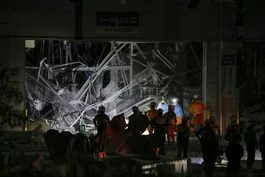
AMNA NAWAZ: We start the day's other headlines in Southern Japan, where a powerful earthquake damaged buildings, roads, and bridges earlier today.
The 6.8-magnitude quake struck Japan's southern main island of Kyushu, triggering a tsunami warning that's since been lifted.
In and around the city of Kumamoto, the quake shook city cameras and toppled buildings, including some centuries-old shrines.
Other structures caught fire.
Officials say that emergency crews are racing to rescue dozens of people who are feared trapped inside a shopping mall.
Following the quake, Japan's prime minister warned that the threat was ongoing.
SANAE TAKAICHI, Japanese Prime Minister (through translator): To those in areas that experience strong shaking, the risk of building collapses and landslides remains high.
Please avoid entering dangerous areas and take all precautions to ensure your safety.
Over the next week or so, please remain alert for the possibility of aftershocks with the maximum seismic intensity of 7.
AMNA NAWAZ: Japanese media is reporting that hospitals in the affected areas admitted dozens of injured people.
Police say one person died in a collapsed house.
But officials say there have been no reports of damage to major public utilities, including several nuclear power plants nearby.
In Seattle, police say that the 15-year-old arrested during this weekend's mass shooting at a food festival used an untraceable ghost gun with an extended magazine.
At a press conference, officials said they continue to look for other possible suspects and believe the violence was gang-related.
Meantime, at a vigil last night, people grieved those who were killed in the shooting.
They have been identified as 44-year-old Carlos Israel Sanchez Villalba and 56-year-old Ashley Whitehead.
Officials say the third fatality was a 19-year-old gunman.
At least four other people were injured.
We have an update for a story we brought you last week now.
The Georgia teenager who shot and killed four people at Apalachee High School in 2024 was sentenced to life in prison today without the possibility of parole.
Last week, Colt Gray pleaded guilty to 55 counts stemming from the attack.
Gray was 14 at the time of the shooting and was charged as an adult.
Florida is set to become the first state in nearly 10 years to carry out two executions in a single day.
Earlier, a former police officer was put to death for killing a young girl in the late 1980s.
And an 80-year-old prisoner is set to be executed this evening for killing his ex-girlfriend's parents in 1986.
Under Governor Ron DeSantis, Florida is continuing an accelerated pace of executions with at least 11 so far this year.
In 2025, Florida executed 19 prisoners, the most in a single year since the death penalty was reinstated nearly 50 years ago.
Across parts of Spain and France, firefighters are trying to rein in massive wildfires before a scorching heat wave sweeps through the region.
Spain's Prime Minister Pedro Sanchez says the country is -- quote -- "turning the tide" against blazes near Madrid.
Thousands of people are being allowed to return home.
But Sanchez warned that difficult hours are still ahead.
Meantime, in France, officials ordered another 4,000 people to evacuate coastal areas as firefighters struggled to keep a massive blaze near Bordeaux under control.
One fire official said the weather is complicating their efforts.
MATTHIEU JOMAIN, Gironde Firefighter Commander (through translator): The situation has rather calmed down, but we can see behind us over there a large number of hot spots starting to emerge.
And with the temperature and unfortunately the wind expected in the area, these hot spots could become the source of a new fire outbreak.
AMNA NAWAZ: One fire in Southwest France grew so strong that its smoke column became a thunderstorm, creating its own lightning and winds.
It's the country's first recorded instance of the phenomenon.
President Trump said today he's inviting a teenage lifeguard to the White House to receive a high civilian honor after video of his dramatic rescue of a young boy went viral.
This footage shows the 16-year-old clinging to the child in a rough surf at a beach in Santa Cruz, California, last weekend.
They eventually made it out safely.
Trump's son Eric was among those who shared the video.
He called for the teenager to receive an official recognition for his efforts.
It wasn't immediately clear whether the invitation has been accepted.
On Wall Street today, stocks ended mixed as weakness in A.I.
shares kept a lid on market sentiment.
The Dow Jones industrial average added more than 500 points.
The Nasdaq lost ground, giving back about 55 points.
The S&P 500 managed a slight gain on the day.
And artist Betye Saar, who was central to the Black arts movements of the 1960s and '70s, has died.
A leading practitioner of assemblage, Saar transformed everyday objects into sculptures over the course of her six-decade career.
Her most famous work, The Liberation of Aunt Jemima from the early 1970s, transformed a derogatory stereotype into a revolutionary armed with rifles and other weapons.
The Los Angeles County Museum of Contemporary Art, which often showcased her work, posted a tribute to Saar today, featuring her reflections on the importance of art.
BETYE SAAR, Artist: Since I was a child, art has been important.
It feeds an inner need that people don't even know they have it until it's taken away.
AMNA NAWAZ: Saar worked well into her 90s, telling The New York Times in 2024 that she feels lucky to have art as part of her life.
The gallery that represents Saar announced she passed away in her sleep on Sunday.
Betye Saar was just four days shy of her 100th birthday.
Still to come on the "News Hour": new reports show the real-world consequences of the Trump administration's cuts to HIV funding; the president's allies on a federal board move to weaken protections for historic sites nationwide; and a renowned baritone works to revive and celebrate the United States' musical traditions.
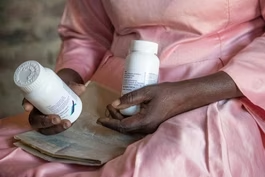
Well, the 26th annual International AIDS Conference is under way in Rio this week, and the collapse of American and international funding for HIV/AIDS is on the minds of many.
A new report details the impact of cuts to the program known as PEPFAR, which has been credited with saving over 26 million lives since it was established in 2003 by President George W. Bush.
William Brangham has more.
WILLIAM BRANGHAM: Amna, that report was done by the global HIV-AIDS nonprofit amfAR.
It surveyed more than 166 organizations in 46 different countries about the impact of PEPFAR cuts and the broader dismantling of USAID by the Trump administration.
It found that more than 1,700 treatment sites globally had been closed.
For some perspective on what this means, we are joined again by Dr.
Atul Gawande.
He was the former assistant administrator of USAID under President Biden, is a writer and a surgeon at Brigham and Women's Hospital in Boston.
Dr.
Gawande, great to have you back on the program.
I mentioned the study from amfAR.
Their details will be presented in Rio tomorrow, but a lot of this we have already seen.
I mentioned already over 1,700 sites have closed.
That's places where people can get treatment, preventative medications, et cetera; 73 percent of groups that provide services to particularly vulnerable groups, sex workers, men who have sex with men, people who use injection drugs, those groups report that they have stopped providing at least one type of service.
More than 63 percent of groups that provide medication to prevent mother-to-child HIV transmission, which we know is such a powerful intervention, have reported disruptions.
Does any of this surprise you?
And what does this mean for the larger fight against HIV/AIDS?
DR.
ATUL GAWANDE, Former USAID Global Health Assistant Administrator: On one hand, it does not surprise me.
On the other, we're now finally starting to see some actual numbers about the magnitude of what's happened.
And here's what I took away that was really significant.
Some key pillars of fighting HIV is being able to get services to people who might be shunned from the medical system, people you named, like sex workers, people who inject I.V.
drugs, gay or transgender people.
The second thing that you have to do is not only get people on treatment.
You have to contact-trace and test people who they are in contact with.
And testing and prevention went way down.
The numbers aren't as sexy as the closing of a clinic, but those are the things that start to happen when you have a surge of HIV return.
The third thing is, there were some reports, for example, from 22 neonatal clinics, a network of hospitals in Africa where newborns come to.
And they found that mothers had a 50 percent jump in HIV rates and over 300 percent jump in those places finding women were not on treatment.
And that means more children are now at risk of being born with HIV.
But we won't know that for a while, especially when you have taken away the testing, taken away preventive measures.
WILLIAM BRANGHAM: Right, taking our eyes basically off this epidemic.
DR.
ATUL GAWANDE: Yes.
WILLIAM BRANGHAM: I want to play something that Winnie Byanyima said recently.
She's the executive director of UNAIDS.
Here's what she said.
WINNIE BYANYIMA, Executive Director, UNAIDS: The question is no longer whether we can end AIDS.
The question is whether we choose to end AIDS.
The end is no longer limited by science.
It's limited by inequality, by political choices.
WILLIAM BRANGHAM: I mean, it seems like the political choices, again, not the scientific choices, the political choices we are making are moving in the opposite direction right now.
DR.
ATUL GAWANDE: One hundred percent.
President Trump, in his first term, actually set the goal, which seemed like a crazy goal, end HIV as a public health crisis by 2030.
But since then, the technologies to make it possible have developed, including the whole range of community health work force going after making sure people don't fall out of the system, the data systems, but then an injection to prevent HIV for six months.
WILLIAM BRANGHAM: Right, lenacapavir.
It's a remarkable drug.
DR.
ATUL GAWANDE: It is.
"Science" journal called it the discovery of 2025.
The administration is rolling it out, but not like you're on a campaign to end HIV by 2030, when you have said South Africa can't get - - is no longer a partner on HIV at all, a place with one quarter of the world's HIV cases.
We don't even partner with them around the development of HIV vaccines, and HIV vaccines have been largely removed from federal funding.
So we are on a path that is not only not ending HIV.It's lost that commitment to saying we're going to even prevent it from resurging.
WILLIAM BRANGHAM: We asked the State Department for comment about this, and they argued that the amfAR's study's methodology was flawed.
They argue, in essence, that preventative and lifesaving treatments and medications are still getting out through different routes, through different partners, through different memorandums of understanding, and that the idea that there is some catastrophe here is misguided.
What is your response to that?
DR.
ATUL GAWANDE: Well, they have made deals with governments to carry out the programs.
Those deals are with far smaller dollars, and so they don't go as far.
They don't provide dedicated services for people who are shunned by the government medical systems that we talked about.
And we already see information like I outlined indicating people are not getting the prevention, they're not getting the testing.
And there are signs even of treatment not getting to people needed, like in the study of mothers with -- who have HIV and are arriving pregnant and not on treatment.
WILLIAM BRANGHAM: While we have you here, I want to ask you about this other outbreak, and that's Ebola.
I believe it's 3,200 cases right now in the DRC Congo.
What is your sense about how that outbreak is going?
DR.
ATUL GAWANDE: Not well.
This is now the third largest outbreak of Ebola in history, and it's on its way to being the worst outbreak ever.
And the reasons why is that our ability to respond was set back from the very beginning by the destruction of a lot of our infrastructure and capacity.
We used to have a full-time adviser with expertise on Ebola in the country.
Not there anymore.
And the investments weren't there anymore.
We have now got a massive spend that's still not keeping track with this disease; 80 percent of the cases are occurring in people who are not even on people's contact lists for tracing.
So we have got a long way to go, and we're not doing the work that would get it under control.
WILLIAM BRANGHAM: Dr.
Atul Gawande, always great to hear from you.
Thank you.
DR.
ATUL GAWANDE: Thank you.
GEOFF BENNETT: It has been four years since the U.S.
Supreme Court's Dobbs decision opened the door to state abortion bans.
Now a new study finds those bans are hurting women who aren't seeking abortions at all.
They're having miscarriages.
That's according to researchers at Oregon Health and Science University.
AMNA NAWAZ: Researchers found delays in miscarriage treatment increase the risk to a woman's health and fertility and prolong the grief of a lost pregnancy.
That weighs heavily on the doctors treating these women.
Special correspondent Sarah Varney traveled to Kentucky and Texas, two states with near-total abortion bans, to speak with OB-GYNs about how these laws are changing how they practice medicine.
DR.
ALECIA FIELDS, OB-GYN: You want to go outside?
SARAH VARNEY: Alecia Fields grew up in Kentucky.
After medical school, she and her husband, Marcus (ph), moved to New York for her residency in obstetrics and gynecology.
DR.
ALECIA FIELDS: There's me.
I had my first baby in residency.
SARAH VARNEY: After graduation, the family moved to this rural Kentucky community in June 2022.
DR.
ALECIA FIELDS: Hi.
BOY: Hi.
DR.
ALECIA FIELDS: How's your day?
BOY: Great.
DR.
ALECIA FIELDS: How you doing?
BOY: Good.
SARAH VARNEY: Her three boys know that their mom delivers babies.
But Dr.
Fields says practicing medicine here in Kentucky has changed since the state's near-total abortion ban went into effect almost four years ago.
DR.
ALECIA FIELDS: We had a case not that long ago where the patient had been seen, she had a really horrible pregnancy history of multiple previable deliveries and losses and preterm labor, and ultimately came in laboring, but she still had a pregnancy with a heartbeat.
And she was begging us to do something, to please make this just be done.
She knew that at 17 weeks a pregnancy could not survive on the outside.
And she was just stuck waiting.
And, ultimately, we were stuck waiting until she got infected and was sick enough to intervene and do something.
SARAH VARNEY: Under Kentucky law, physicians can perform abortions only when patients face death or permanent damage to a major organ.
There are no exceptions for pregnancies resulting from rape or incest or fatal fetal conditions.
How did you deal with watching this patient of yours be in pain and suffer?
DR.
ALECIA FIELDS: It really is difficult to sit back and feel like your hands are tied and that you can't help them.
You can't do anything.
You can sit with them, you can hold space with them, you can support them, but you can't do anything for them.
SARAH VARNEY: Doctors here face up to five years in prison and the loss of their medical license if they go against the ban.
DR.
ALECIA FIELDS: That's very terrifying and humbling as a physician to work so long and hard to get to this point in my career and finally be practicing.
And any sort of legal charge that would take that all away is scary.
I'm the sole income provider for my family.
They depend on me for everything financially and health insurance.
And so that that's a huge risk.
DR.
ANITRA BEASLEY, OB-GYN: We are practicing in a place where people are so, so, so scared.
And that's a terrible way to practice.
SARAH VARNEY: Eight hundred miles away in Houston, Dr.
Anitra Beasley feels that same dread.
The prison sentences here are steep, up to 99 years, and the threat of civil lawsuits by so-called bounty hunters.
DR.
ANITRA BEASLEY: So when you are saying, can this person have an abortion, you're not just thinking about, is it what this patient needs?
You may also be thinking about, what is this going to mean for me?
What does it mean if I make the wrong decision?
What if someone sues me?
Am I going to still be able to practice medicine?
Am I going to still be able to take care of my family?
Am I still going to be able to see my family?
Will I be in jail?
SARAH VARNEY: Dr.
Beasley grew up here, and today she lives in a leafy Houston neighborhood with her husband and three kids.
As an OB-GYN, she treats mostly poor and uninsured Texans.
DR.
ANITRA BEASLEY: They walk into the room and are unsure if they can trust the information that they are getting from their physician.
SARAH VARNEY: From you.
DR.
ANITRA BEASLEY: Right.
And so I might not be able to convince someone that I am trustworthy, simply because of the environment that we're in.
SARAH VARNEY: Republicans in the state legislature and the Texas Medical Board have attempted to clarify when physicians like Dr.
Beasley can intervene to prevent a medical catastrophe.
The board recently disciplined three Texas doctors who delayed giving medical care to two pregnant patients experiencing miscarriage.
The women died as a result.
DR.
CHRISTINA FRANCIS, OB-GYN: You know, I have to say, from the laws that I have read that are currently on the books, I think that they are actually very clear.
SARAH VARNEY: Dr.
Christina Francis says the confusion and hesitation experienced by Dr.
Fields and Dr.
Beasley is unnecessary.
She works at a hospital in Indiana taking care of women in labor or those hospitalized for pregnancy complications or emergencies.
DR.
CHRISTINA FRANCIS: I think the problem is that many doctors have not actually read the law or haven't talked to lawyers who are accurately interpreting what the law means.
SARAH VARNEY: We met her in Washington, D.C., where Dr.
Francis spends part of her time advocating against abortion as the head of the American Association of Pro-Life OB-GYNs.
DR.
CHRISTINA FRANCIS: I wonder how many of these physicians that are afraid to act, has anyone told them that there have been -- Texas, for instance, has documented hundreds of terminations of pregnancy since their law went into effect for their life of the mother exception.
Not a single doctor has been charged or prosecuted because of their intervention in that situation.
SARAH VARNEY: I mean, they are reading the same laws that you're reading, and they're working in hospital systems that are interpreting this to mean, how sick do you have to be, that you couldn't get ahead of a sepsis infection, that you couldn't do an abortion until you had a fever of some amount, right?
DR.
CHRISTINA FRANCIS: So there's actually - - there's nothing in any law that says that a woman has to be a certain level of sick before you can intervene.
It says, in your reasonable medical judgment, if you think that this condition potentially poses a life... SARAH VARNEY: Death... (CROSSTALK) SARAH VARNEY: ... potential?
DR.
CHRISTINA FRANCIS: Or poses a life-threatening risk to a patient.
SARAH VARNEY: It says to save the life of a woman.
DR.
CHRISTINA FRANCIS: Sure.
But there's... SARAH VARNEY: It doesn't say potential.
It doesn't say possible.
DR.
CHRISTINA FRANCIS: There's no time in medicine -- there's no other time in medicine in which we wait until someone is actively dying, if there was a time that we could intervene.
I mean, certainly, sometimes women come in and they're on the verge of death and you haven't had the opportunity to intervene.
But there's not another time in medicine or in law that dictates medicine where we interpret saving a patient's life to only mean intervening once they are on the verge of death.
SARAH VARNEY: Dr.
Anitra Beasley argues there are no laws that can account for all the complexities of pregnancy.
DR.
ANITRA BEASLEY: It's like if my house was on fire and the firefighters came in their truck and they connected their hoses and they had all the water and they had all of the equipment that they needed, and they just stood there and said, I can't help you.
That's what it feels like.
SARAH VARNEY: Dr.
Francis says she's never felt that way in Indiana.
DR.
CHRISTINA FRANCIS: Just my group alone, I don't know the exact number, but what patients that I can think of over the last few years, it's at least dozens of patients who we have intervened in a previable state because she was facing a potentially life-threatening complication.
And, again, we haven't even gotten a second look from the hospital, because, of course, we just do what we need to do to take care of our patients.
SARAH VARNEY: Dr.
Fields says she would love to do just that, but the laws in Kentucky have fundamentally changed how she's allowed to practice medicine.
Why have you chosen to stay?
DR.
ALECIA FIELDS: I think for every day that I have a hard scenario of one of these situations that I want to just like bang my fist against the wall, I have moments on the other side where I have those patients that are so appreciative of the fact that they have a reproductive health care provider in the state, in a rural area that's going to listen to them without shame, without guilt, and validate their experiences.
So that's why I stay, because they deserve access to good care.
SARAH VARNEY: Have you ever thought of leaving Texas?
DR.
ANITRA BEASLEY: I think everyone probably has.
It's really hard to practice medicine with your hands tied behind your back.
But this is where I'm from.
My home is here, my family is here, my community is here.
This is where I have built my life.
So, just packing that all up to go somewhere else and start over is difficult.
But, also, I care about my community.
SARAH VARNEY: For "PBS News Hour," I'm Sarah Varney in Houston.
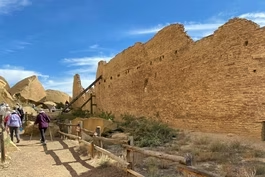
AMNA NAWAZ: An advisory council packed with allies of President Trump voted Friday to weaken federal oversight of construction projects affecting historic sites.
GEOFF BENNETT: Critics of the president's controversial projects in Washington are concerned that this move will open the floodgates to endangering preservation of historic and cultural places across the country.
Senior arts correspondent Jeffrey Brown looks at the bigger picture behind this latest move for our arts and culture series, Canvas.
JEFFREY BROWN: President Trump's proposed arch on a traffic circle in Arlington, Virginia, Native American cultural sites in New Mexico's Chaco Canyon, two of the thousands of historic structure sites and more that could be impacted by a proposed change to rules governing construction on federal lands, plus a new executive directive to place signs outside the Smithsonian National Museum of American History calling into question the exhibitions inside.
Joining me to discuss both is Philip Kennicott, culture critic for The Washington Post.
And thanks so much for joining us.
Let's start with this proposed change to what's known as Section 106 of the National Historic Preservation Act of 1966.
Tell us how it works now and what might change.
PHILIP KENNICOTT, The Washington Post: Well, at this point, if the federal government wants to develop a piece of property or make changes that would impact a federally historically protected site, they have to go through a process.
And that process is essentially one of consultation.
They have to talk to the states and potentially to Native American tribes.
And they also have to solicit input from the public.
What's just happened is that the federally appointed body that controls this process has just issued a new set of rules that essentially gut the law.
It would minimize the number of properties that are eligible for review.
It would minimize the kinds of impacts that are considered relevant.
And, most important, it would effectively cut the public entirely out of the process if the government decides they don't want to solicit your opinion and they don't want to hear it.
JEFFREY BROWN: And in terms of potential impact, now, I mentioned two that are well-known, the controversial arch in D.C.
and Chaco Canyon in New Mexico.
What other kind of sites are potentially impacted here?
PHILIP KENNICOTT: This is essentially the big triumphal arch in Washington coming home to a site anywhere near you.
It would impact historic sites all over the country, large and small.
It essentially would allow, theoretically, if a developer wanted to make changes, say, put a golf course next to a historic home or historic landscape,if they got the ear of the president or even the ear of somebody well placed within the relevant federal agency, they could get the public process basically shut down.
They could -- the federal government would decide, no, we don't want to hear from you.
And that will greatly speed the development of that property, no matter the consequences.
JEFFREY BROWN: Now, this change is being led by a little known agency.
It's called the Advisory Council on Historic Preservation, all with appointees by President Trump.
Do you expect legal challenges to come?
PHILIP KENNICOTT: Oh, yes, I think those are already in the works.
And once these laws have gone through the process and been published, you will see a number of avenues that people pursue in legal cases.
I think one of these is that the changes are not consistent with the procedures of the Advisory Council on Historic Preservation.
And they're not consistent with the larger law, the 1960 law on historic preservation.
They also cut a lot of relevant parties, interested parties, like the states and tribes, out of this process.
And so they will have an interest in contesting this as well.
JEFFREY BROWN: All right, so let's turn to this other development that happened recently, President Trump's directive to put warning sides outside the Museum of American History.
We don't know what those signs will say, but this is clearly part of the continuing attack he's made against the Smithsonian at large.
What do you see happening?
PHILIP KENNICOTT: Well, yes, as you're right.
We don't know what the actual particulars of the signs will say.
But they seem to be an effort to basically breach the trust of the public with the Smithsonian.
The president has issued a report that really condemns the Smithsonian for divisiveness, for its focus on wokeness or DEI.
But these reports and these previous efforts to belittle and beleaguer the institution really haven't had much purchase yet.
This seems to be a little bit of theater that's meant to sort of garner attention.
The president has ordered the National Park Service, another greatly beloved part of the federal government that interacts with the people, to put these signs up.
So, effectively, what it's doing is pitting one beloved group against another, the congressionally chartered Smithsonian Institution.
JEFFREY BROWN: So two different developments, two different areas in some ways.
Do you see any connecting tissue here between the two things we have just talked about?
PHILIP KENNICOTT: Well, I think it's about controlling how we tell history, whether that's at the material level of a building or when it comes to the narratives that are intertwined and unfolded in a place like the Smithsonian.
Authoritarian-minded regimes have always understood that there is both an material and an intellectual aspect of history.
And if you can erase history in the material world, in the built world, you assert great power to actually erase narratives in places like the Smithsonian.
And if you have that power, then, of course, you can control the present and the future.
JEFFREY BROWN: There is an argument that these regulations take too long, that projects go on for years and years, so something needs to be changed in the way this is governed.
PHILIP KENNICOTT: Well, they can cite a couple of cases perhaps where they have been burdensome and taken a long time to do, but we could cite, I think, many, many more cases in which a little bit of deliberation, a little bit of time, a little bit of thoughtfulness has preserved important historic and cultural places.
One has only to think about the speed with which the president demolished the East Wing of the White House to get a perspective on what could happen to historic sites all over the country if this supposedly burdensome process is made essentially effortless, so long as you can get the relevant agencies to follow your particular view of the situation.
JEFFREY BROWN: All right, Philip Kennicott is culture critic of The Washington Post.
Thanks so much.
PHILIP KENNICOTT: Thank you for having me.
GEOFF BENNETT: His is a household name in the classical vocal traditions that have their roots in Europe.
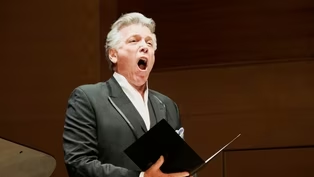
But for more than 25 years, Thomas Hampson has dedicated himself to reviving and celebrating American traditions in song.
Fred de Sam Lazaro went to see that on full display in Aspen, Colorado, for our arts and culture series, Canvas.
FRED DE SAM LAZARO: "My days have been so my days have been so wondrous free," which seemed like a fitting start to a concert held on Independence Day weekend, composed, after all, by one of the signers of the Declaration of Independence, Francis Hopkinson, drawing from the poetry of Thomas Parnell.
Thomas Hampson grew up in Spokane, Washington, and had a storybook path to stardom, attending prestigious music academies before his lyrical baritone was discovered.
He's performed some 80 opera roles around the world and is a renowned recording artist as well in the solo vocal tradition of leader.
But along with the European greats from Schumann to Verdi, he's also loved the American tradition in song, like Charles Ives, or Harry Burleigh, the prolific 19th century African American composer.
Hampson says nothing compares to the rich variety of song in America.
THOMAS HAMPSON, Baritone: To me, it's the essential e pluribus unum statement.
FRED DE SAM LAZARO: Which does not imply homogeneity.
THOMAS HAMPSON: No, it's exactly not homogeneity; e pluribus unum does not mean the deletion of the difference.
In fact, it means listening to the difference.
FRED DE SAM LAZARO: Here at the Aspen Music Festival, he showcased that difference with a program varied in culture, geography, and period in American song accompanied by pianist Myra Huang and on some works like this by 19th century songwriter Stephen Foster violinist Jerusha Taylor.
THOMAS HAMPSON: I think in this very volatile time we're in that one of the great refuges is the arts and humanities and the stories of who we are, especially as America.
FRED DE SAM LAZARO: The works were selected from an online library called Song of America.
Hampson began compiling it decades ago in partnership with the Library of Congress.
THOMAS HAMPSON: All of these composers and poets, they were asking us, what does America sound like when it remembers itself?
FRED DE SAM LAZARO: All of the works today saw the composer draw from poets who came before.
There were works by 20th century composers like Aaron Copland and Margaret Bonds, the latter using the poetry of Langston Hughes.
From contemporary composer Jennifer Higdon, "The Death of Lincoln," with words from William Cullen Bryant.
THOMAS HAMPSON: Can you teach history through song?
Heavens, yes.
It's fantastically interesting.
All of the songs are tips of icebergs.
We could spend an hour going through every one of them with all the wonderful anecdotal connections.
If any of you are teachers in whatever field in American studies, I will give you a song to augment your teaching plan.
FRED DE SAM LAZARO: His Song of America library was built to be accessible to teachers to increase the visibility overall of a cultural treasure that a commercialized market makes no room for.
And he says song can provide a safe space for reckoning with skeletons in America's cultural closet, notably issues around race or sexual orientation.
He closed with "To What You Said," a Walt Whitman poem that Leonard Bernstein put to song, some scholars think because it speaks of repressed love at a time Bernstein was having a sexual identity crisis.
THOMAS HAMPSON: You know, people are very agitated today about the indoctrination of young people because of this or that path of education.
You can either dam up the ocean or you can teach people to swim.
And I prefer to teach people to swim.
What I sing, is infinitely more important than who I am.
We must listen to one another.
FRED DE SAM LAZARO: Hampson now lives in Austria.
He continues to teach and perform around the world.
For the "PBS News Hour," I'm Fred de Sam Lazaro in Aspen, Colorado.
AMNA NAWAZ: Appalachia is often stereotyped as a region defined by struggling coal mine towns and substance abuse.
Writer Emilee Hackney says those portrayals don't reflect her life growing up in Southwestern Virginia.
Her debut memoir, "All That's Unseen," covers growing up inside that world and the political influences that came to shape it.
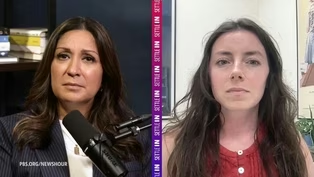
I spoke to her for the latest episode of our PBS News podcast "Settle In."
Here's a clip of that conversation.
You talk about hearing folks back at home as they're learning about candidate Donald Trump, President Donald Trump, about him gaining popularity in Appalachia.
They like that he told it like it is, things we have heard in a lot of communities where he has strong levels of support.
Did his strength and his support in the place that you call home, did all that make sense to you at the time?
EMILEE HACKNEY, Author, "All That's Unseen: An Appalachian Memoir": Absolutely.
I mean, most of the people I knew were Trump supporters right from the very beginning, because he comes to Appalachia and he says, I'm going to help you.
He pays attention.
He makes us feel seen for the first time in decades.
And when you are coming from a place that's really struggling, like Appalachia often does, or at least coalfield Appalachia, you have to trust in whoever offers you hope, because what else is there?
What else do you hope in?
So, yes, at first, I was like, maybe this is the way.
Maybe he's actually going to help.
Maybe -- yes, maybe this is right.
And I write about going to a rally that he held in Southwest Virginia at Radford University and feeling just the tension of that room didn't feel right to me.
And the way that he behaved, like seeing him in person kind of turned me off from the idea of him.
But if I hadn't gone to that rally, I don't know.
I don't know if -- I think it would have taken me a longer time to change my opinion of him.
And, even still, when I was at Harvard, I still had conflicted feelings about him because so many people I knew back home were still so supportive of him.
And he was early in his first presidency, and we have seen him do a lot of things that now I'm like, oh, my gosh, how could I ever have supported him?
But at that point, it didn't -- it hadn't gotten to that point yet.
And so I had these conflicted feelings about him.
And once I started really looking into his policies, or lack thereof, in one of my writing classes, in my investigative journalism class, that was what finally I guess made me move -- it -- and started to move me in a different direction.
AMNA NAWAZ: You have probably seen the comparisons being made now, right, between your book and the book written by Vice President Vance, "Hillbilly Elegy," about his time growing up in Appalachia and then in Ohio.
Do you buy those comparisons?
Do you agree with them?
EMILEE HACKNEY: He makes a lot of generalizations about Appalachia based on his own experiences, his own anecdotal experiences.
And I don't feel like those are fair characterizations to make.
I think that he probably encountered a lot of what I did.
So I go up to Harvard.
He goes to Yale,.
And he writes about being an oddity to people at Yale, to New Englanders, and I felt that way too.
And I encountered this big appetite for, what is Appalachia?
Like, what are people like?
Everybody has a stereotype in their head.
But I think that he saw that people wanted to know more about Appalachia and those stereotypes because we were on the heels of the 2016 election.
Appalachia was being talked about as being so red, so Trump-supporting.
I just feel like he capitalized on that appetite.
And he saw that people wanted to know more about Appalachia, but maybe not really.
They just wanted confirmation of what they already thought about it.
And I think he plays into those stereotypes by using his own stories from his childhood to say, like, all of Appalachia is addicted, like, addiction is endemic, it's such a problem, it's all over, poverty, it's just so widespread.
And I just feel like that's a flattened and non-nuanced characterization of Appalachia.
He cannot speak for Appalachia as a whole, as he does in his book.
AMNA NAWAZ: You feel like his anecdotes, his story don't directly relate to what you experienced growing up in a different part of Appalachia?
Is that fair?
EMILEE HACKNEY: It is.
Yes, I don't think that his story could speak for anybody else's.
So in my book, I'm very careful to say this is my experience in Appalachia.
It's not going to be everybody's.
And I don't think that he does the same thing.
He's not careful that same way.
AMNA NAWAZ: And you can watch that full conversation and more episodes of "Settle In" on our YouTube page or wherever you get your podcasts.
GEOFF BENNETT: And now some late-breaking news.
U.S.
Central Command says Iran launched several ballistic missiles toward an American military base in Jordan this evening.
AMNA NAWAZ: This is the first such attack by Iran since President Trump paused strikes on the Islamic Republic late last week.
The U.S.
says all Iranian missiles in this latest attack were intercepted.
GEOFF BENNETT: Well, that is the "News Hour" for tonight.
I'm Geoff Bennett.
AMNA NAWAZ: And I'm Amna Nawaz.
On behalf of the entire "News Hour" team, thank you for joining us.
 New
NewEmilee Hackney joins Amna Nawaz on 'Settle In'
Video has Closed Captions
On 'Settle In,' Emilee Hackney and Amna Nawaz discuss Appalachian stereotypes (5m 9s)
 New
NewFederal board votes to weaken historic site protections
Video has Closed Captions
Board packed with Trump allies votes to weaken protections for historic sites (6m 15s)
 New
NewGraham remembered for impact on South Carolina and the world
Video has Closed Captions
Lindsey Graham remembered for impact on South Carolina and the world (6m 11s)
 New
NewHow state abortion bans are affecting doctors
Video has Closed Captions
How state abortion bans are affecting doctors and how they practice (9m 24s)
 New
NewNetanyahu and Zelenskyy meet separately with Trump
Video has Closed Captions
What Netanyahu and Zelenskyy are hoping to accomplish after meetings with Trump (4m 21s)
 New
NewNews Wrap: 6.8 magnitude earthquake hits southern Japan
Video has Closed Captions
News Wrap: 6.8 magnitude earthquake hits southern Japan (6m 40s)
 New
NewReport reveals consequences of Trump's HIV/AIDS funding cuts
Video has Closed Captions
New report reveals consequences of Trump administration's HIV/AIDS funding cuts (7m 30s)
 New
NewThomas Hampson celebrates U.S. art with 'Song of America'
Video has Closed Captions
Thomas Hampson celebrates U.S. musical history with 'Song of America' (6m 25s)
Providing Support for PBS.org
Learn Moreabout PBS online sponsorship New Episode
- News and Public Affairs

Today's top journalists discuss Washington's current political events and public affairs.

- News and Public Affairs

FRONTLINE is investigative journalism that questions, explains and changes our world.
 New Episode
 New Episode
 New Episode
 New Episode
 New Episode
 New Episode


 New Episode
 New Episode
Support for PBS provided by:
Major corporate funding for the PBS News Hour is provided by BDO, BNSF, Consumer Cellular, American Cruise Lines, and Raymond James. Funding for the PBS NewsHour Weekend is provided by...