
How American English evolved from its British roots
Clip: 8/6/2026 | 4m 25sVideo has Closed Captions
How American English evolved from its British roots
How did American English become so distinctly American? On her “In Pursuit of Happiness” podcast, Judy Woodruff sat down with linguists Anne Curzan and Valerie Fridland. They look at how Americans from the very beginning reshaped the English language by changing pronunciations and spellings, creating new words and evolving dialects.
Problems playing video? | Closed Captioning Feedback
Problems playing video? | Closed Captioning Feedback
Major corporate funding for the PBS News Hour is provided by BDO, BNSF, Consumer Cellular, American Cruise Lines, and Raymond James. Funding for the PBS NewsHour Weekend is provided by...
How American English evolved from its British roots
Clip: 8/6/2026 | 4m 25sVideo has Closed Captions
How did American English become so distinctly American? On her “In Pursuit of Happiness” podcast, Judy Woodruff sat down with linguists Anne Curzan and Valerie Fridland. They look at how Americans from the very beginning reshaped the English language by changing pronunciations and spellings, creating new words and evolving dialects.
Problems playing video? | Closed Captioning Feedback
Where to Watch PBS News Hour
PBS News Hour is available to stream on pbs.org and the PBS app.
Providing Support for PBS.org
Learn Moreabout PBS online sponsorshipGEOFF BENNETT: Finally, tonight: How did American English become so distinctly American?
AMNA NAWAZ: Judy Woodruff explores that question and others in this week's "In Pursuit of Happiness" podcast with two linguists, Anne Curzan and Valerie Fridland.
JUDY WOODRUFF: I want to ask the two of you to take us back to that period and even before, Anne, and remind us what was it about the English language at the time of the Declaration, and even before, that was -- it was beginning to be different from British, or was it?
Was it all sounding British?
ANNE CURZAN, Linguist, University of Michigan: It's such a great question.
And I think that, when we look at the language of 1776, it can look really familiar because we can read the Declaration of Independence and the Constitution and understand them.
And so sometimes I will hear, well, English really hasn't changed since then.
And I say, oh, yes, it has.
And you can find all these things in the Declaration of Independence, for example, like a hath instead of a has.
And that's -- there's a reason when you study the history of English for that, or there's a reason that the spelling actually still looks British in the Declaration of Independence, because we had not yet had this American reform of spelling, which we can talk about.
So I'm going to let Valerie talk a little bit about sort of the sounds of the language in terms of what was happening in the United States as English had been brought to North America and where - - and it's really important for people to remember how many languages were already being spoken in North America.
So you have hundreds of Native American languages, along with French and Dutch and Spanish, all of these languages being spoken in the U.S.
as English arrives, and that's really important for understanding what happens to English as different settlers from different parts of England and then Scotland and Ireland come to the United States.
So, with that, Valerie, I have set you up... JUDY WOODRUFF: Yes.
ANNE CURZAN: ... to talk a little bit more about the sound.
JUDY WOODRUFF: It is astonishing to hear you say hundreds of Native American languages.
But fill this out for us, Valerie.
How were we sounding back then?
VALERIE FRIDLAND, Professor of Linguistics, University of Nevada: I get asked a lot, what would we have sounded like at the time of the revolution?
Would we have still sounded British?
That's actually a question that people want to know a lot.
And there are -- it's -- obviously, we didn't have iPhones back then.
It would have been super helpful, but we did have people that wrote more like they spoke.
So we do have some misspellings, particularly in the colonial period, that give us hints as to how people sounded.
We also had, as Anne referenced, a period of spelling reform following the revolution that was both part of this simplified spelling movement, which was English doesn't look like how it sounds, and can we make that less complicated?
Noah Webster was part of that.
So was Benjamin Franklin.
But, also, can we make American English different from British English in part by changing the way it is spelled?
So someone like Benjamin Franklin is very helpful for telling us how people sounded at that era because he actually made a phonetic alphabet... VALERIE FRIDLAND: ... to represent things as they were spoken and wrote that way, until he kind of gave it up, realizing that no one else was going to jump on his bandwagon.
But there were three main periods in how we sounded, and one would have been the very early colonial period, where it would have been very British for the British settlers, but also you had, as Anne referenced, a lot of other settlers.
But the basic answer is, yes, at the time of the revolution, it probably would have sounded more British than American to us.
There probably wasn't that big of a difference between the way that a lot of Southern British people spoke in the way they did in, for example, Philadelphia or Boston at that time.
But it would have sounded very different from both modern British speech and modern American speech, because many of the vowels were in flux at the time, and some of the consonant differences that we have now, like the way we flap the T to make it more D like in words like water or bottle, would not have yet happened.
So it would have been quite different from speech in either place today.
AMNA NAWAZ: And you can watch this full conversation and all episodes of "Pursuit of Happiness" on our YouTube page or wherever you get your podcasts.
FAA investigating jet takeoff during Marine One flight
Video has Closed Captions
Plane takeoff during Marine One flight renews concerns about D.C.'s busy airspace (5m 10s)
Greece uses satellite detection system to combat wildfires
Video has Closed Captions
Greece deploys satellite detection system to combat deadly wildfires (9m 10s)
Group targets campaign cash used for misconduct legal fees
Video has Closed Captions
Group pushes for ban on using campaign funds for legal fees in misconduct cases (6m 16s)
Head Start faces major changes under Trump proposal
Video has Closed Captions
A look at the major changes Head Start faces under Trump proposal (7m 5s)
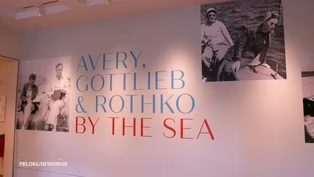
How summers by the sea shaped three great American painters
Video has Closed Captions
Exhibition reveals how summers by the sea shaped three great American painters (5m 59s)
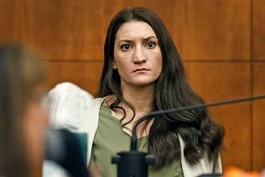
Murder trial put postpartum psychosis in spotlight
Video has Closed Captions
What is postpartum psychosis? The condition at the center of Lindsay Clancy's murder trial (7m 36s)
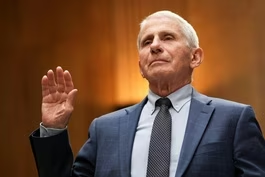
News Wrap: Senate committee votes to hold Fauci in contempt
Video has Closed Captions
News Wrap: Senate committee votes to hold Fauci in contempt of Congress (6m 50s)
Providing Support for PBS.org
Learn Moreabout PBS online sponsorship New Episode
- News and Public Affairs

Today's top journalists discuss Washington's current political events and public affairs.

- News and Public Affairs

FRONTLINE is investigative journalism that questions, explains and changes our world.

 New Episode
 New Episode
 New Episode
 New Episode
 New Episode
 New Episode
 New Episode
 New Episode
Support for PBS provided by:
Major corporate funding for the PBS News Hour is provided by BDO, BNSF, Consumer Cellular, American Cruise Lines, and Raymond James. Funding for the PBS NewsHour Weekend is provided by...