
April 15, 2023 - PBS News Weekend full episode
4/15/2023 | 26m 45sVideo has Closed Captions
April 15, 2023 - PBS News Weekend full episode
Saturday on PBS News Weekend, investigative journalists unravel the story of African migrants crossing the Atlantic in search of better lives who ended up thousands of miles off-course. Then, what can be done to curb sexually transmitted infections in the U.S., especially those passed along to newborns. Plus, the story of the first federally funded relocation of a tribe due to climate change.
Problems playing video? | Closed Captioning Feedback
Problems playing video? | Closed Captioning Feedback
Major corporate funding for the PBS News Hour is provided by BDO, BNSF, Consumer Cellular, American Cruise Lines, and Raymond James. Funding for the PBS NewsHour Weekend is provided by...
April 15, 2023 - PBS News Weekend full episode
4/15/2023 | 26m 45sVideo has Closed Captions
Saturday on PBS News Weekend, investigative journalists unravel the story of African migrants crossing the Atlantic in search of better lives who ended up thousands of miles off-course. Then, what can be done to curb sexually transmitted infections in the U.S., especially those passed along to newborns. Plus, the story of the first federally funded relocation of a tribe due to climate change.
Problems playing video? | Closed Captioning Feedback
How to Watch PBS News Hour
PBS News Hour is available to stream on pbs.org and the free PBS App, available on iPhone, Apple TV, Android TV, Android smartphones, Amazon Fire TV, Amazon Fire Tablet, Roku, Samsung Smart TV, and Vizio.
Providing Support for PBS.org
Learn Moreabout PBS online sponsorshipJOHN YANG: Tonight, on PBS News Weekend, investigative journalists unravel the story of African migrants whose search for a better life ended up thousands of miles off target and ended their lives.
RENATA BRITO: They came from countries in West Africa, in the south, where there is not just poverty and lack of opportunities for young men, but there is also conflict, political instability, and they simply wanted better lives.
JOHN YANG: Then what can be done to curb sexually transmitted infections in the United States, especially those passed along to newborns.
And the story of the first federally funded relocation of a community because of climate change.
(BREAK) JOHN YANG: Good evening.
I'm John Yang.
Tonight, control of the North African nation of Sudan appears to be up for grabs after months of rising tensions.
The Sudanese military and a powerful paramilitary force led by rival generals engaged in fierce fighting, including in the capital city of Khartoum.
Details are hard to come by, but a doctor's group says at least 25 people are dead and nearly 200 injured.
People sheltering from the fighting say they saw gunfire in the streets and heard fighter jets overhead.
Black smoke billowed throughout the Capitol, and houses were left in ruins from shelling.
The paramilitary force claims it has seized the presidential palace and the airport.
Secretary of State Antony Blinken, traveling today in Vietnam, called for an end to the violence.
ANTONY BLINKEN, U.S. Secretary of State: It's a fragile situation.
This is a real opportunity to finally carry forward the civilian led transition and one that we and other countries are trying to bolster.
JOHN YANG: In December, Sudanese political parties agreed to move toward a democracy after an October 2021 military coup.
In Japan, an explosion just feet from Prime Minister Fumio Kishida disrupted a campaign event.
Police tackled a man who officials said had thrown a suspicious object.
The prime minister was whisked away unharmed.
The incident was reminiscent of the assassination of former Prime Minister Shinzo Abe nine months ago at a similar event.
In France, President Emmanuel Macron signed into law the controversial pension measure that gradually increases the age of retirement from 62 to 64 starting in September.
The changes follow months of sometimes violent protests that injured hundreds of people.
The government says the reforms are necessary to keep the pension system afloat amid an aging population.
Labor unions are calling for a mass protest on May 1st, which is International Workers Day.
And families of Boston Marathon bombing victims laid wreaths at the spot near the finish line where the explosion killed three people and injured hundreds of others 10 years ago today.
The 127th Boston Marathon will be run on Monday.
Still to come on "PBS News Weekend," a look at the troubling spike in sexually transmitted infections and a native tribe in Louisiana relocates to escape rising sea levels.
Last year, more than 2,000 migrants died while attempting to reach Europe by crossing the Mediterranean Sea.
Now we're learning about a longer and more dangerous route across the Atlantic.
A new Associated Press investigation has uncovered the desperate and sometimes deadly journey many African migrants are taking.
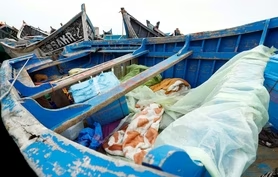
The reporting centers on a boat that drifted thousands of miles from the coast of Mauritania in Africa to Tobago in the Caribbean.
Those on board were in search of a better life in Europe but never made it.
AP journalists Renata Brito and Felipe Dana spent nearly two years unraveling the story of the boat and of the lives of the people in it.
Thanks so much for joining us.
First of all, before we get into the actual story, tell us what they were leaving.
RENATA BRITO, Reporter, Associated Press: Of course.
First of all, as far as we know, they're all men.
We were able to identify by name 33 of the 43 people believed to have boarded this boat.
They came from countries in West Africa and the Sahel, from Mauritania, from Mali, from Senegal, where there is not just poverty and lack of opportunities for young men, but there is also conflict, political instability, the effects of climate change on their livelihoods.
The situation is only getting worse and they simply wanted better lives.
JOHN YANG: This story began about two years ago in Tobago when a boat washed up.
Tell us a little bit about that.
RENATA BRITO: When it first appeared, it made the local news and the police found out quickly that the boat was from Mauritania.
But apart from that they didn't have any information on the people who had boarded it, why they had died, who they were and why this boat was found drifting.
We saw this news, not just me, but other journalists, migration experts and we noticed how similar it was to the boats being used by migrants to reach the Canary Islands, these islands off the coast of northwest Africa that are used as a stepping stone to reach Europe.
And we immediately thought this might be a case of a group of migrants and potentially refugees who were trying to reach Europe and got lost in the Atlantic and their boat ended up on the other side.
JOHN YANG: How were you able to find out who these people were?
As you say, you named 33 of them.
How were you able to trace them back and you even spoke to their family members?
FELIPE DANA, Visual Journalist & Editor, Associated Press: Yes, well, that was a long process.
We went to where we believe they were trying to reach the Canary Islands and then we gather evidence there.
We were able to get phone numbers that were retrieved from SIM cards of some cellphone that were in the boat and that's how we began to basically call every number and create a list and try to find out more.
RENATA BRITO: And from calling those numbers, we basically found who the owner of the phone was and that he had gone missing after boarding a boat from Nouadhibou and Mauritania with a lot of other young men from his region and also from neighboring countries from Mali and Senegal.
And so we went back to their hometowns, many of them spoke to their families, compiled the information together.
And then we went to Tobago, looked at the evidence there, sent it back to their families who were able to recognize some clothing.
And ultimately we managed to do a DNA test confirmation for one family.
And now the Red Cross after our investigation has gone to collect more DNA samples to see if there are more matches that can be made with the remaining bodies in Tobago.
JOHN YANG: In some cases, I imagine you were delivering the first news that these families were having of their loved ones?
FELIPE DANA: Yes.
As journalists, we used to -- when we do these kind of stories, we're not usually the ones that have to give that information.
But what happened was, especially in Mauritania when we were meeting the families, they really didn't know anything about what happened to their loved ones and they just knew when they left and that's it.
And were in a very difficult position to have to share with them what we knew, that was - - that most likely their relatives, their sons and husbands were on the other side of the Atlantic and that there were no survivors.
JOHN YANG: On the other side of the Atlantic.
They were trying to get to the Canary Islands.
They ended up thousands of miles away in the Caribbean.
Is this an isolated incident or are there other incidents like this?
RENATA BRITO: There are other incidents like this, as we found out in our investigation and in most of the cases, the victims are rarely identified.
And basically what happens is because of the winds in the Atlantic, especially the trade winds, when you miss -- if you miss your target, you know, they're on very overcrowded boats often that are not, you know, being navigated appropriately.
They're not meant for such voyages.
The engines -- FELIPE DANA: Underpowered, yes.
RENATA BRITO: Yes, underpowered.
And so if you miss your target, the Canary Islands, you end up in the middle of the ocean and the winds are against you.
They push you to the other side of the Atlantic.
JOHN YANG: It's a fascinating and very sad tale.
Renata Brito and Felipe Dana of the Associated Press, thank you very much.
FELIPE DANA: Thank you.
RENATA BRITO: Thank you.
JOHN YANG: New numbers from the CDC show a surge of sexually transmitted infections in the United States with no signs of slowing.
In 2021, there were 2.5 million cases of chlamydia, gonorrhea and syphilis.
The most significant rise was in syphilis and congenital syphilis, which occurs when mothers with the infection pass it along to their babies during pregnancy.
From 2020 to 2021, cases of each went up 32 percent.
Ali Rogin has more on this concerning trend.
ALI ROGIN: Over the past decade, there's been about an eightfold increase in the cases of congenital syphilis in the United States.
In 2012, the numbers were at historic lows thanks to robust contact tracing and public health efforts.
But infections have gone up every year since.
And syphilis in babies is much more serious than in adults carrying a risk of stillbirth and long term health problems.
Here to talk about what can be done to address this is Dr. Irene Stafford.
She's an OBGYN and maternal fetal medicine specialist at UT Health, Houston.
Dr. Stafford, thank you so much for joining us.
Let's talk first about why STIs in general are on the rise in the United States.
DR. IRENE STAFFORD, The University of Texas Health Science Center at Houston: Thank you again so much for having me.
The rise in STIs in this country is multifactorial.
Part of it is inconsistent screening patterns, especially with people that are in special risk groups.
Unfortunately, our emphasis should be placed on offering and encouraging routine screening for STI in every health encounter.
Sexual health in general really seems to be underemphasized due to a lack of screening.
Unfortunately, other significant issues such as access to care, funding, lack of available clinics, all of these factors contribute to the rising rates of STI.
ALI ROGIN: And then how about congenital syphilis in particular?
Is that part of the overall increase in STIs that we're seeing?
DR. IRENE STAFFORD: As a matter of fact, there's been over a 30 percent increase in all cases of syphilis infection and particularly perinatal syphilis where a mother who is infected with syphilis can pass it to her baby.
We've seen over a 30 percent increase in congenital syphilis cases in the last several years.
ALI ROGIN: And things were going so well.
As we mentioned in 2012, cases were at a historic low and now they've increased.
So how did things go so wrong?
DR. IRENE STAFFORD: I believe that partially we are not being vigilant about screening and treating pregnant women.
Unfortunately, according to the CDC data, about 30 percent of women don't have access to care.
On top of that, there's been a certain percentage that have actually been screened for syphilis but did not get timely treatment.
And lastly, there's been a surge in cases where women have converted and become infected with syphilis during the third trimester.
ALI ROGIN: And if it's not, what are the symptoms?
What are the consequences of not treating congenital syphilis?
DR. IRENE STAFFORD: Well, unfortunately, the infection itself during pregnancy carries a 30 percent to 40 percent perinatal loss rate.
If the baby does survive during the pregnancy and is born with congenital syphilis, sadly, the baby will be in the neonatal intensive care unit for over a week, in some cases longer.
The baby can have blood problems, liver problems, bone problems.
And probably one of the biggest consequences is when the infection itself affects the central nervous system or the brain of the newborn.
That can lead to neurosyphilis, which is quite detrimental and hard on a newborn baby and the family, of course.
ALI ROGIN: So you're seeing these patients every day once somebody comes in for treatment for a syphilis diagnosis.
What does that look like?
DR. IRENE STAFFORD: My responsibility, and I think the responsibility of most health providers is actually to counsel the patient, talk to her about the need for treatment, oftentimes with syphilis, especially when it's been there for a long time, that level of infection and stage of infection requires multiple doses of penicillin.
So the counseling component is critical to help patients understand the need for continued surveillance and follow up so that we can treat her adequately for her stage of infection.
ALI ROGIN: And what about the role of COVID-19?
We saw lots of resources being reallocated to account for COVID.
Was congenital syphilis part of that reallocation of resources?
DR. IRENE STAFFORD: Absolutely.
We did everything we could to reduce contact for patients to reduce the spread of COVID-19, but unfortunately, that alienated a lot of patients.
Their favorite clinic on the corner of, say, broad and fifth closed, they didn't know where they could go.
So those kind of changes in the actual structure of healthcare really impacted STI screening, especially for infections like syphilis that can often be asymptomatic.
Not all patients have complaints.
It can be a rash that people think might be eczema and so forth.
So oftentimes they don't bring that to the physician's attention, and definitely not when they're not face to face with a physician.
ALI ROGIN: So what can people be doing to protect themselves from getting and transmitting congenital syphilis?
DR. IRENE STAFFORD: I think to begin with, physicians, providers, everyone out there needs to actually start prioritizing sexual health.
I mean, this is a call to action.
The CDC just came out with a statement that it is time for us to use every resource we can to help encourage patients, regardless of risk factors, to get screened and treated for STI.
In addition, patients need to self-advocate.
Ad if they're, you know, at the physician's office, go ahead and talk about sexual health with your provider, especially when you're pregnant.
If you're concerned about syphilis infection, use protection.
We've seen in the data that people are using condoms, unfortunately less and less to protect themselves from STI.
ALI ROGIN: Dr. Irene Stafford with UT Health, Houston.
Thank you so much for your time.
DR. IRENE STAFFORD: Thank you for that.
JOHN YANG: Last year, the Biden administration said it would pay to help move five Native American tribes from coastlines and rivers where waters are rising due to climate change.
Special correspondent Megan Thompson reports on an earlier relocation effort in Louisiana that led to some unexpected complications.
CHRIS BRUNET, Isle de Jean Charles Resident: Well, it's the only place that ever known as home.
This is where my whole life experiences are.
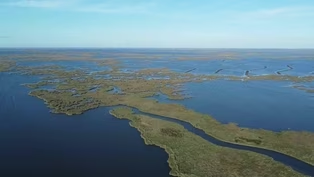
MEGAN THOMPSON: For almost all of his 58 years, Chris Brunet lived in one place, Isle de Jean Charles, a sliver of an island on Louisiana's Gulf Coast.
Brunet is also tied to this land through his ancestry.
He's a member of the Jean Charles Choctaw nation.
CHRIS BRUNET: We are one with the island, and the island is one with us.
MEGAN THOMPSON: The tribe traces its roots to a Native American woman who settled here with her French husband in the early 1800s.
Their children married people from nearby indigenous tribes, and the community eventually grew to around 400.
Reverend Roch Naquin is Chris Brunet's uncle.
Over his 90 years, he's seen the island change dramatically.
ROCH NAQUIN, Reverend: When I was little, I didn't see any water on the land.
Everything was dry all the time.
MEGAN THOMPSON: Back then, Isle de Jean Charles was about 5 miles wide.
Today, it's only about a quarter mile wide.
There are many reasons for that.
Sea levels are rising, while at the same time, the land beneath Louisiana's coast is sinking.
Thousands of canals used by oil and gas companies have made erosion worse.
And Mississippi River levees block sediment from naturally restoring the wetlands.
All this as increasingly intense hurricanes pound the coast.
CHRIS BRUNET: And we are still here.
MEGAN THOMPSON: When the News Hour first met Chris Brunet in 2012, his house looked like this.
This is his home today.
In 2021, Hurricane Ida ripped off a corner of the house and damaged the elevator.
Next door, Ida's winds destroyed his uncle's roof.
DEME NAQUIN, Jean Charles Choctaw Nation Chief: I lost about everything.
MEGAN THOMPSON: Over the years, flooding and storms drove residents away, and the island's population dwindled to only a few dozen, mostly Native American.
For tribal leadership, the writing was on the wall.
Deme Naquin is the new chief of the Jean Charles Choctaw Nation.
DEME NAQUIN: So they came up with a plan.
They had a good plan to move as a community, move everyone together.
MEGAN THOMPSON: In the early 2000s, tribal leadership began planning a new community to reunite the scattered tribe at a new location 40 miles north, and most importantly, 10 to 12ft above sea level.
DEME NAQUIN: The goal was to bring everyone back together.
MEGAN THOMPSON: The tribe partnered with a nonprofit and the state of Louisiana to apply for funding.
Then, in 2016, big news, the Federal Department of Housing and Urban Development awarded Louisiana $48 million for the first federally funded relocation of a community because of climate change.
After six years of planning and construction, families began to move in last year.
ROCH NAQUIN: Come on in.
MEGAN THOMPSON: They're calling the community the new aisle.
On a winding road of modest homes, 34 families have moved in so far.
Three more are expected to arrive this year.
ROCH NAQUIN: This room eventually is going to be a prayer room.
MEGAN THOMPSON: Reverend Naquin lives in a two bedroom, two bath and was able to choose the layout and paint colors.
ROCH NAQUIN: I love the house.
I tell people, this is the most luxurious house that I ever lived in.
MEGAN THOMPSON: Naquin lives next door to his nephew, just like before.
For Chris Brunet, leaving the only home he's known has taken some getting used to.
PAT FORBES, Louisiana Office of Community Development: I'm grateful that a house was built.
I'm grateful for that.
It's home because I'm surrounded by the people I've known my whole life, but it's still not all the way home.
It's absolutely an innovative approach to adapting to climate change.
MEGAN THOMPSON: Pat Forbes runs the Louisiana State Office of Community Development.
Because the Jean Charles Choctaw Nation doesn't have federal recognition, Forbes office received the money and oversaw the project.
PAT FORBES: One of the most important lessons we learned was that you have to talk to people on a personal, individual level to understand where they're coming from and what their priorities are.
MEGAN THOMPSON: Residents told him they wanted a community center, so one is being finished now.
Another example the houses here don't need to be on stilts.
But Forbes learned the space underneath homes on Isle de Jean Charles often functioned as a place to gather.
PAT FORBES: Now you'll see, every single house has a covered outdoor space.
MEGAN THOMPSON: The houses were also designed to withstand hurricane force winds.
PAT FORBES: The windows are all double paned.
There is an extra layer of impermeable covering between the shingles and the roof.
MEGAN THOMPSON: For some residents, like Chris Brunet, who's on disability because of cerebral palsy, these extra features create an unexpected problem.
The value of his new home is higher than its last one, so property taxes and insurance will also be higher.
PAT FORBES: How can you put me in a position that requires me to afford more than what I can afford if this is about climate change?
The long term success of this whole experiment depends on people's being able to afford to live here for the long term.
MEGAN THOMPSON: Forbes says this future marketplace could help by creating jobs and generating rent revenue to offset the higher costs so could a proposed health clinic or other commercial projects.
But there's no concrete solution yet.
Though this might look like a success story, the leadership of the Jean Charles Choctaw Nation doesn't see it that way.
DEME NAQUIN: Once the funding was issued, the tribe had nothing to do with it.
The tribe had no say so it's like they stole it from us.
MEGAN THOMPSON: The chief at the time wrote a letter to HUD calling for the grant money to be returned, saying the project was no longer for and led by the tribe.
DEME NAQUIN: What this project was supposed to be was to be for the tribe, and it was supposed to be keep our heritage, culture all in one spot.
PAT FORBES: What we found when we started interviewing folks on the island was that not everybody on the island is part of the tribe.
We couldn't say we're going to put all the decision making authority with the tribe.
MEGAN THOMPSON: Forbes says they couldn't build homes for people who'd left the island long ago because the federal money was from a disaster resilience program related to Hurricane Isaac in 2012, so only current residents and people who'd lived there when Isaac hit qualified.
PAT FORBES: Do I wish that the tribe would work more closely with us to bring more people back here who used to live on the island?
Absolutely.
MEGAN THOMPSON: The state's offering free plots of land to anyone who left before 2012, 27 families have signed up so far, but the building costs will ultimately fall on them.
The state also offered to sell the tribe a parcel of land, but Chief Naquin questions why the tribe should pay after it helped secure the grant that bought the land in the first place.
DEME NAQUIN: It was supposed to have been a model to the rest of the world, it hasn't happened.
CHRIS BRUNET: There are different ways of looking at it optimistically.
There are different ways of looking at it negatively.
MEGAN THOMPSON: Chris Brunet feels his community has been preserved because he's still surrounded by his neighbors from Isle de Jean Charles.
The island is mostly deserted now, but Brunet was allowed to keep his property, so he visits as often as he can.
To his new home, he brought a big tub of the marsh grass that grows in the shallow waters off the island.
CHRIS BRUNET: Because it reminds me of what I come from.
And then also its resiliency to want to grow, to want to come back.
MEGAN THOMPSON: Far from home, but still able to thrive.
For PBS News Weekend, I'm Megan Thompson in Gray, Louisiana.
JOHN YANG: Now online this Instagram story on the Environmental Protection Agency's proposal to update emissions regulations for new gas powered vehicles.
All that and more on our website, pbs.org/newshour.
That is PBS News Weekend for this Saturday.
I'm John Yang.
For all of my colleagues, thanks for joining us.
See you tomorrow.
The fateful journey of 43 African migrants lost at sea
Video has Closed Captions
Clip: 4/15/2023 | 5m 53s | Journalists retrace fateful journey of a group of African migrants lost at sea (5m 53s)
Native tribe highlights challenges of climate migration
Video has Closed Captions
Clip: 4/15/2023 | 8m 13s | Native tribe in Louisiana highlights challenges of climate-driven relocation (8m 13s)

U.S. sees concerning rise in STIs, congenital syphilis
Video has Closed Captions
Clip: 4/15/2023 | 6m 23s | U.S. sees concerning rise in STIs, congenital syphilis with no signs of slowing (6m 23s)
Providing Support for PBS.org
Learn Moreabout PBS online sponsorship
- News and Public Affairs

FRONTLINE is investigative journalism that questions, explains and changes our world.

- News and Public Affairs

Amanpour and Company features conversations with leaders and decision makers.












Support for PBS provided by:
Major corporate funding for the PBS News Hour is provided by BDO, BNSF, Consumer Cellular, American Cruise Lines, and Raymond James. Funding for the PBS NewsHour Weekend is provided by...