
Massachusetts Cranberry Harvest
Clip: 6/15/2026 | 5m 39sVideo has Closed Captions
Discover the hard work involved in bringing in the harvest in the cranberry bogs of Massachusetts.
Discover the hard work involved in bringing in the harvest in the cranberry bogs of Massachusetts.
Problems playing video? | Closed Captioning Feedback
Problems playing video? | Closed Captioning Feedback
America's Heartland is presented by your local public television station.
Funding for America’s Heartland is provided by US Soy, Sustainable Agriculture Research and Education, Rural Development Partners, and a Specialty Crop Grant from the California Department of Food and Agriculture.
Massachusetts Cranberry Harvest
Clip: 6/15/2026 | 5m 39sVideo has Closed Captions
Discover the hard work involved in bringing in the harvest in the cranberry bogs of Massachusetts.
Problems playing video? | Closed Captioning Feedback
How to Watch America's Heartland
America's Heartland is available to stream on pbs.org and the free PBS App, available on iPhone, Apple TV, Android TV, Android smartphones, Amazon Fire TV, Amazon Fire Tablet, Roku, Samsung Smart TV, LG TV, and Vizio.
Providing Support for PBS.org
Learn Moreabout PBS online sponsorship>>A lot of us would agree that holidays like Thanksgiving wouldn't be the same without cranberries.
Whether you like them jellied or whole, the colorful fruit is the perfect addition to the meal.
And if you want a fruit that's truly American look no further than the cranberry.
The red berries were being used for food and fabric dyes long before the first European settlers arrived.
Our Sarah Gardner says cranberries have been part of both American history and the history of one particular family.
♪♪ >>We landed in with the Mayflower in 1620, the surname Walker came in 1635, and my mother's family landed in 1632.
That's hundreds of- of years of a tradition.
>>Annie Walker is the owner of Annie's Crannies cranberry farm on Massachusetts' Cape Cod.
It's a unique farming operation dating back before the American Revolution.
>>With the exception of 36 years, this land has only been worked by the Nobscussett Indian Tribe, the Hall family, and the Walker Family.
>>A number of native varieties of cranberries grow in the wetland bogs of Massachusetts.
The state has some fourteen thousand acres devoted to the bright red fruit.
>>What I grow is called 'Howes,' H-O-W-E-S.
The Howes berry was cross-pollinated and cultivated on Scargo Lake here in Dennis in 1847.
So when it came time for me to renovate the bog, I chose to plant Howes berries because it's native to here.
>>Cranberry production here is so rooted in antiquity that even crop yields are measured differently.
No bushels here, think instead of barrels like those found on old sailing ships.
>>A barrel is approximately a hundred pounds.
I think the average for Howes is about 120 barrels an acre.
And on my best year I've grown over 450 barrels to the acre of Howes.
>>There are two methods of harvesting cranberries, wet pick and dry pick.
>>The wet pick cranberries represent about 95 percent of all the cranberries in Massachusetts.
They're ultimately gonna be used in juice, sauce, sweet and dry cranberries, those sort of products.
And it's a three-day process.
The first day they flood the bog.
Then they drive out with harvest machines, and they literally knock the cranberries off the vines.
And they float to the surface because they have air pockets inside of 'em.
And then the third part of it they corral the fruit and pump it off of the bog and into the trucks.
>>Annie, who prefers selling cranberries as fresh fruit, employs the dry pick method using a motorized, walk-behind harvester.
>>It's got teeth on the front, which is like combing your hair, so when you dry pick, you always go in the same direction around clockwise.
And the paddles push the berries up into a burlap bag.
>>She also uses a two-handed comb scoop for the edges of the bog.
>>This scoop is from about 1950.
It weighs about three pounds... empty.
And that's all I do.
So I go in here and scoop the edges and rock it forward and pull forward.
What it- what it does is it leaves the vine, it pulls up all the runners, and then I go back and I hand prune this with a pruning rake to get rid of these runners.
>>The crop eventually makes its way to a separator, this one built more than a hundred years ago.
>>This is still how they do them in market is in through these separators.
There's been nothing new invented since 1905.
When they go in the separator there's bounce boards.
A good dry berry bounces.
They have chances to hit the board and bounce forward.
If they hit the board and it doesn't bounce forward, it will drop to the rotten bins in the bottom.
Those actually become... juice.
So we check the front.
This looks like a happy hive.
We'll see if they're happy.
>>With bees necessary to pollinate the cranberry crop, Annie maintains hives all around her bogs.
>>If the bees don't kiss the flowers, we don't get cranberries- it's that simple.
>>In addition to established honeybee colonies, farmers here are attracting native bees, butterflies and other pollinators by growing certain kinds of wildflowers.
>>'Cause you don't want plants that are going to compete and be a pest on the bogs.
You also don't want them to be in bloom when the cranberries are in bloom.
>>The bees are happy, we're happy, 'cause they have to pollinate the food source.
So, if this helps get them through the winter, this will give them a fall honey source for the winter, then next spring-summer when I need my bog is in full bloom in the end of June through mid-July, then the bees will be happy, they'll stay here and they'll go out on the bog.
The best part of this experience is that I'm able to save something that my grandfather, great-grandfather, great-great-grandfather did and pass it on to the next generation.
The best day of the year for me is a Labor Day party where the whole family comes and partakes.
And that, sharing it with the family, is the best.
♪♪ >>Do you like cranberry juice?
The Phytochemicals in cranberries are a good source of healthful anti-oxidants.
But cranberry juice is no new health food invention.
Early settlers to New England began consuming cranberry juice in the 1600s.
And the vitamin C in fresh and dried cranberries helped early American sailors prevent scurvy while at sea.
♪♪
 New
NewVideo has Closed Captions
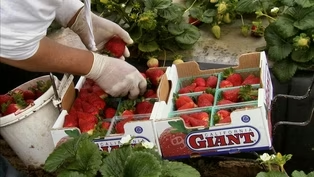
See how California farmers find new overseas markets for their bright red strawberries. (4m 57s)
 New
NewVideo has Closed Captions
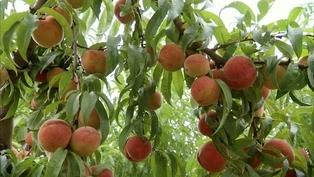
Meet a South Carolina family that’s been raising prize-winning peaches for nearly a century. (6m 25s)
 New
NewVideo has Closed Captions
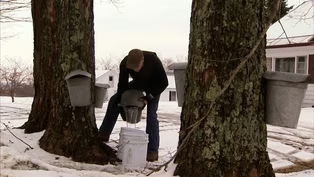
Tap into the successful operation of maple sugaring in Vermont. (5m 46s)
Providing Support for PBS.org
Learn Moreabout PBS online sponsorship

- Food
Christopher Kimball’s Milk Street Television
Transform home cooking with the editors of Christopher Kimball’s Milk Street Magazine.











Support for PBS provided by:
America's Heartland is presented by your local public television station.
Funding for America’s Heartland is provided by US Soy, Sustainable Agriculture Research and Education, Rural Development Partners, and a Specialty Crop Grant from the California Department of Food and Agriculture.