
December 20, 2025 - PBS News Weekend full episode
12/20/2025 | 26m 45sVideo has Closed Captions
December 20, 2025 - PBS News Weekend full episode
December 20, 2025 - PBS News Weekend full episode
Problems playing video? | Closed Captioning Feedback
Problems playing video? | Closed Captioning Feedback
Major corporate funding for the PBS News Hour is provided by BDO, BNSF, Consumer Cellular, American Cruise Lines, and Raymond James. Funding for the PBS NewsHour Weekend is provided by...
December 20, 2025 - PBS News Weekend full episode
12/20/2025 | 26m 45sVideo has Closed Captions
December 20, 2025 - PBS News Weekend full episode
Problems playing video? | Closed Captioning Feedback
How to Watch PBS News Hour
PBS News Hour is available to stream on pbs.org and the free PBS App, available on iPhone, Apple TV, Android TV, Android smartphones, Amazon Fire TV, Amazon Fire Tablet, Roku, Samsung Smart TV, and Vizio.
Providing Support for PBS.org
Learn Moreabout PBS online sponsorshipJOHN YANG: Tonight on PBS News Weekend,# as the Justice Department releases more## material on Jeffrey Epstein, critics# complained about heavy redactions.
Then,## how companies may be using AI to sift through your# personal data online to set individualized prices.
And a conversation with world renowned animal# scientist and autism advocate Temple Grandin,## whose portrait is now in the# National Portrait Gallery.
TEMPLE GRANDIN, Professor of Animal Science,# Colorado State University: Like, you got to## be kidding.
I think it's like.. get the call from Sweden, they just can't# believe it.
I almost couldn't believe it.
(BREAK) JOHN YANG:## Good evening.
I'm Jo.. more heavily redacted pages of material# it had gathered on convicted sex offender## Jeffrey Epstein.
Still, what's been# made public so far falls well short## of the full disclosure required by# the law Congress passed last month.
These new releases come in addition# to the thousands of pages of photos,## correspondence and other material# released on Friday afternoon.
And## the Justice Department says there will# be much more to come in the coming weeks.
Among the latest batch, released around# midnight, is a phone message slip that reads,## she has females for Mr.
J.E.
Jeff Mason is a# White House correspondent for Reuters.
Jeff,## these new files, the files even# that were released yesterday,## tell us a lot about more detail about# Jeffrey Epstein.
But does it tell us## anything about his relationship with# Donald Trump?
With President Trump.
JEFF MASON, White House Correspondent,# Reuters: Very little.
And that's one## thing that people were maybe anticipating# getting more informa.. have some mentions of Trump and# some conversations, but no photos.
One of the pieces of evidence that# people were expecting was not in## the release.
And in general, the# files were focused on other people## in Jeffrey Epstein's orbit and not the# current president of the United States.
JOHN YANG: Even with that, this is now going to# be spread out over several weeks.
It's not going## to be a one day story, one day headline.
Does the# White House have a strategy to deal with that?
JEFF MASON: Well, their strategy so far has# been largely to say, A, that they are being## very transparent by taking or taking doing# this document release and following the law.## A statement from a White House spokeswoman# yesterday pretty much said just that and## accused Democrats of not answering questions# about their connections with Jeffrey Epstein.
I think broadly, the White House would be# happy for this whole issue to go away.
And## that is evidenced by the fact that President# Trump spent months trying to prevent these## documents from coming out.
That led to# a lot of discord within his MAGA base## and led to some divisions within Congress# about amongst Republicans.
In the end,## they ended up passing this law# and the president signed it.
But some Democrats and in fact, at# least one Republican are saying that## the administration did not follow the# law with its limited release on Friday.
JOHN YANG: Well, one of those# Republicans is the co-sponsor,## Representative Thomas Massie of Kentucky.# He tweeted today that the release grossly## fails to comply with the law.
What can they# do?
Can they go to court and sue over this?
JEFF MASON: Well, that's a good question.
I# don't know if that's something that they're## thinking of doing.
Certainly I do know, because# this is what the Justice Department has said,## is that they're planning to release more,# but they are saying that there are so many## things that have to go through that they just# couldn't basically do it all in one batch,## but that there will be multiple# additional batches coming.
But as you say, even the co-sponsor# of the bill on the Republican side,## Congressman Massie, is upset about that.
JOHN YANG: And also, these documents# are so heavily redacted.
There are## some pages that are just totally# black from being blacked out,## inked out.
Is anybody talking about# that or complaining about that?
JEFF MASON: Yes, there are concerns about that.# I think in one case, there were 100 pages of## grand jury testimony that were redacted.# Now, the law allows the Justice Department## to release some of the files with redactions# in specific instances with regard to victims## of Jeffrey Epstein's crimes, with regard# to abuse.
But the amount of the redactions## surprised people who are expecting to get# more information than they felt they received.
JOHN YANG: And the law actually# says they can't redact to protect## the reputation of anybody.
Anybody.
Do# we have any idea when these additional## files are going to be released in the future?
JEFF MASON: All we know is that they'll be coming## out in batches in the coming weeks.
So# I would expect that journalists like## ourselves will be watching this story over# the holidays and probably well past that.
And some of the questions that people were hoping## to get answered in this first batch are# the ones that will continue to be asked## in terms of connections that other# people had and knowledge that other## people had of Jeffrey Epstein and his crimes.
JOHN YANG: You mentioned this split in the MAGA## base and it spread to the House Republicans.
Does# any of this threaten support for President Trump?
JEFF MASON: Well, I mean, exhibit A of that# is the rift now between President Trump and## Congresswoman Marjorie Taylor Greene, who threw# her support behind this legislation and behind## additional transparency for the Epstein files# that led to this major break with the president,## with whom she had a close relationship.# And the two of them have really been MAGA,## you know, very connected in the MAGA# base and supported by the MAGA base.
So to your question, will there be more?
It's# hard to say, but certainly Congresswoman Greene## has suggested that there are more divisions# coming or more breakaways coming from within## the base and within the Republican Party over# multiple things.
But certainly a lot of it seems## to have been triggered by this.
JOHN YANG: Jeff Mason of Reuters,## thank you very much.
JEFF MASON: My pleasure.
JOHN YANG: In the day's other## headlines, Russia struck Odessa's port# facilities in southern Ukraine overnight.## Eight people were killed and 27 injured.
It# comes after Moscow threatened to cut Ukraine## off in the Black Sea.
Russia also says# it's taken control of two more Ukrainian## villages in the Donetsk and Sumy regions,# despite U.S.
efforts to get a ceasefire## agreement the Ukrainian soldier fighting# in Donetsk said it would be meaningless.
HRUBYI, Ukrainian Artilleryman (through# translator): I don't believe in a ceasefire.## It's all just empty talk.
Why?
Because Putin# will gather more forces, regroup and .. JOHN YANG: A Russian envoy arrived in Miami# today for talks on a U.S.
plan to end the## war.
Yesterday, Ukrainian negotiators began# separate talks with U.S.
officials in Miami.
The Israeli army struck a school in Gaza City# that was sheltering displaced people.
The dead## and wounded were taken to Al Shifa Hospital.# Among the seven killed were six members of Nafez## al Nassr's family who were asleep.
He said he# was celebrating a wedding in a nearby classroom.
NAFEZ AL-NATHR (through translator):# We dispersed in panic, looking for## our loved ones, and we saw body# parts everywhere.
The children,## the elderly, the young women, body parts# everywhere.
The joy stopped immediately.
JOHN YANG: The Israeli military told PBS News# that had been targeting a number of suspicious## individuals, but is aware of a claim of civilian# casualties and that the details are under review.## Hamas called it a brutal crime and yet# another violation of the cease fire agreement.
U.S.
Central Command has released video# of Friday's U.S.
strikes on more than## 70 targets in Syria said to be Islamic# State fighters and weapons.
It was the## retaliation that President Trump had# promised after an ambush attack last## week killed two U.S.
troops and# a civilian American interpreter.
The Jordanian air force confirmed# that it joined the U.S.
operation## to prevent extremist groups from# threatening regional security.
And a paraplegic engineer from Germany has# become the first person who uses a wheelchair## to go to space.
It was a dream come true for# Michaela Benthouse.
She blasted off aboard a## Blue Origin capsule along with five other space# tourists.
The 10 minute suborbital space flight## was intended to let the passengers experience# a few minutes of weightlessness in outer space.
Still to come on PBS News Weekend, how online# retailers use AI to adjust prices based on what## they think you're willing to pay.
And# celebrating the life of Temple Grandin,## the renowned animal scientist and# advocate for people with autism.
(BREAK) JOHN YANG: Today is Super Saturday, the last# Saturday before Christmas.
It's predicted to## be the second busiest shopping day of the year.
If# you're going online to buy some last minute gifts,## there's a chance the price you'll pay# will be influenced by what's known as## surveillance pricing.
That's the practice# of some retailers to use the power of AI to## sift all sorts of personal data center# to set individualized prices online.
Things like your age, gender, geographic# location and even browsing history could## change the price you pay.
Ali# Rogan spoke with Jay Stanley,## senior policy analyst for the Speech# Privacy and Technology Project at the ACLU.
ALI ROGIN: Thank you so much for joining us.
So# what is surveillance pricing and how does it work?
JAY STANLEY, Senior Policy Analyst, ACLU:# Surveillance pricing is basically when## companies gather a huge amount of data# about they're individual customers.
And## we're living in an era where more data is# being collected about us than ever before.## Companies take that data and they use# it to try to figure out basically how## to wring more money out of you# when you buy things from them.
What is your pain point?
What are you willing to# pay, questions like that.
And there's a widespread## experimentation happening with that kind of# pricing in a number of business sectors today.
ALI ROGIN: So what are some examples of# that?
How are these companies using the## massive amounts of data that exist# about all of us online to give us## these I've heard it described# as like personalized pricing?
JAY STANLEY: I mean, right off the bat, there's# a lot we don't know because, number one, they're## going to claim trade secrets.
Number two, they're# using AI, which is very opaque in the first## place.
Even the businesses may not understand# what the logic of the AI they're using is.
But this first came into public attention# when the president of Delta Airlines,## speaking to investors, said that they were# planning on using AI to set an increasing## proportion of their prices, their airline# prices, and that they would use personal## information about people to do so.
That created# a bit of an uproar in Congress and elsewhere,## and Delta backed off and said, no,# no, we're not going to do this.
But it really put the issue which# has been out there for, you know, 10,## 15 years on a low key level, really# put it into the headlines recently.## And so we're seeing attention by# Congress, by state legislatures,## by the Federal Trade Commission and others.# There was a recent report that Instacart has## been doing differential pricing.
A consumer group# did a test and they found that 75 percent of the## products instacart were getting set with# different prices with different people,## with some of the prices 23 percent higher# than for some people, than for others.
The Wall Street Journal has reported that# retailers like Home Depot were setting## different prices for different customers,# with customers in affluent areas actually## getting charged less.
I think that there's# a lot we don't know about what's happening,## but it's definitely going on.
ALI ROGIN: What is the difference## between this type of surveillance# pricing and some other examples## and types of differential pricing that we've# seen out there already, like dynamic pricing?
JAY STANLEY: I think that the core element# of surveillance pricing or personalized## pricing is that it's based on data they have# about you.
It's different from, you know,## charging more for an umbrella when it's raining.# It's different from Uber charging different## prices at different times of day depending# on the amount of demand for their cars.
Although there have been allegations that Uber,## for example, charges more to people whose# battery's about to die and things like that## would be personalized pricing.
Uber has denied# that.
There can be very complex and sometimes## subtle differences among the different types# of pricing and that can make it complicated.
But at the end of the day, they have a lot# more information about the way the world works,## about how different people react to# different pricing, different than any## individual does.
And they are seeking to use# that advantage information against individuals.
ALI ROGIN: But all of this is legal,# right?
And the corollary question to## that is what regulations exist or should exist# to put some guardrails around this practice?
JAY STANLEY: It's not totally clear that it's# legal.
It's a bit of a legal gray area.
There are,## for example, privacy laws, state privacy laws such## as California's that may have things to# say about this and the way data is used.
There are civil rights laws that have to# do with discrimination based on anything## based on ethnicity, religion, age,# gender, disability status could get## a company in hot water if what they're# doing starts to implicate those things.
There are state consumer laws, and then# there's the Federal Trade Commission,## which has a charge to go after deceptive# and unfair trade practices.
And there could## be claims that some of these# fall under that.
And in fact,## the FTC has been investigating this.
They# did investigation a report last January,## and there's a Reuters report that they're looking# at it again under the current administration.
So if you're a business that are doing this,# you are not necessarily on solid legal ground.
ALI ROGIN: Is there anything that consumers can do## to protect themselves from the possibility# of being targeted with surveillance pricing?
JAY STANLEY: It's difficult.
I mean, at the end of# the day, a lot of these are bigger than any one of## us.
They're social questions, for example.
I mean,# one of the big problems here is that so much data## about us is being collected and flowing to the# companies that give them advantages over us.
And that's because Congress hasn't failed# to pass an overarching privacy law,## as almost all the other sort of advanced# industrial countries have done.
That would## cut off the flow of data at the source# that is fueling this kind of strategy.
But certainly you can do your best to hide your## identity when you're searching for prices.
You# can do your best to protect your privacy and be## aware of it and check and see whether people# you know are getting charged the same price.
ALI ROGIN: Jay Stanley with# the ACLU, thank you so much.
JAY STANLEY: Thank you.
JOHN YANG: Earlier this month, four new# portraits went on view at the Smithsonian## National Portrait gallery in Washington, D.C.# they're this year's recipients of the Portrait## of America Award for their transformative# contributions to American history and culture.
One of them is Temple Grandin.
She's not only# transformed animal welfare around the world,## she's also changing the public perception of# people with autism.
This weekend's Spotlight is## part of our ongoing coverage of the intersection# of arts and Health, part of our canvas series.
DAVID LENZ, Artist: She's a# giant.
I mean, she is a legend.
JOHN YANG (voice-over): Artist David Lenz# painted the portrait of Temple Grandin.
DAVID LENZ: I wanted people to come# into the museum and see a beautiful## portrait of a person who's done amazing# work, who also happens to have autism.
JOHN YANG (voice-over): It depicts# Grandin wearing her trademark outfit,## an embroidered shirt and bolo tie.
And of course,# she's on a cattle farm surrounded by livestock.
DAVID LENZ: They have very beautiful# eyes.
It's easy to see that these are## warm blooded feeling animals that# are worthy of our humane treatment.
JOHN YANG (voice-over): The humane treatment# of livestock has been Grandin's life's work.## As a child, she didn't speak until she was# nearly four.
The doctors who diagnosed her## with autism recommended putting her# in an institution.
Her mother refused.
Now Grandin considers her unique# mind her greatest strength.## Her perspective was key to her# groundbreaking redesign of cattle## handling facilities to eliminate things# that could frighten or unnerve livestock.
Today, her principles guide the way nearly# half of cattle in North America are handled.## She's also helped ease anxiety for people with# autism.
As a teenager, she designed a squeeze## machine to gently apply a calming pressure like# a giant hug.
She based it on a device she saw## on a cattle farm to hold livestock in place# for vaccinations, health checks and the like.
TEMPLE GRANDIN: When you walk back by# him, you gotta do kind of a quick motion.
JOHN YANG (voice-over): Grandin# has a PhD in animal science and## is a professor at Colorado State University.
TEMPLE GRANDIN: And who wants to let this one out?
JOHN YANG (voice-over): She was the# subject of an award winning HBO movie.
WOMAN: I could see the world in a new way.
I# could see details that other people were blind to.
JOHN YANG (voice-over): and was on Time's# list of the 100 people who most affect our## world.
And she's written more than a dozen# books.
Her talks and book signings draw big## crowds.
She says her story demonstrates# the importance of having different kinds## of thinkers.
A message highlighted# by the presence of her portrait in## the National Portrait Gallery.
It will# be on view there until next November.
JOHN YANG: Earlier, I sat# down with Temple Grandin.## I asked her what she thought of her portrait.
TEMPLE GRANDIN: I think it's absolutely# gorgeous.
I was so happy when I first saw## it this beautiful.
I kind of like# the kind of misty rainbow in it,## really like that.
Our experiment# station cattle look just great in that.
JOHN YANG: How did it feel when they told you were# going to go into the National Portrait Gallery?
TEMPLE GRANDIN: Like, you got to be kidding.
I# think it's like some of the Nobel Prize winners,## they can -- when they get the call from Sweden,## they just can't believe it.
I almost couldn't# believe it going, you got to.. JOHN YANG: Now explain why there# are cattle in this portrait.
TEMPLE GRANDIN: Well, cattle is what I have# worked with.
I've worked on designing facilities## for cattle.
I've worked on developing animal# welfare guidelines, teaching people in the## industry how to use them.
I started out in# the feed yards in Arizona back in the early## seventies.
Handling of cattle was dreadful,# and I worked on designing better facilities.
I also wrote a lot of articles just on how to# on cattle behavior, how to design things.
I saw## that cattle handling as something you could# fix.
Now, today, cattle handling is greatly,## greatly improved.
The livestock associations# have training materials.
You have to have both## good equipment and.
And the management.
Good# equipment makes good handling easier.
And you## have top management in a place that insists# on handling cattle and other animals right.
Large customers like McDonald's and other large# customers are auditing animal welfare.
Handling## has really improved, and that's something I'm very# proud of, the improvements I've seen in that.
JOHN YANG: I know you don't want to be known# specifically or mostly for being someone with## autism, but I've also heard you say that it helped# you in your work with cattle and livestock.
TEMPLE GRANDIN: Well, I'm an extreme# object visualizer.
Everything I think## about is a picture.
So the very first work# I did with cattle is I got down in a chute## to see what cattle were seeing.
They'd stop# at a shadow, they'd stop at a reflection,## they'd stop at a pickup park next to the facility.# And visual distractions affected their behavior.
Now, at the time that I did this, in my 20s,# I thought everybody was a visual thinker.
And## it was kind of shocked to me when I found# out that they weren't.
In my latest book,## Visual Thinking, I discussed the research on# object visualizers.
Like me, then you have## more mathematical pattern thinkers then you have# word thinkers.
Problem with us object visualizers## is we can't do higher math.
But I worked# with people that were undiagnosed autistic.
They had big machine and welding shops, and they# were inventing and patenting mechanical devices.## And I'm very concerned that these people are# getting screened out of our educational system.
JOHN YANG: In this case, different is a strength.
TEMPLE GRANDIN: Yes.
JOHN YANG: How does that play into how# you ta.. how you talk to families who# may have children with autism?
TEMPLE GRANDIN: Well, autism goes all the way# from Einstein and Bill Gates to somebody that## never learns to speak.
I learned to speak# by age 4.
I was good at art.
My ability in## art was always encouraged.
Object visualizers are# good at art, mechanical animals, and photography.## So things that object visualizers are good at.# Terrible at abstract math.
Can't remember it.
But I worked with all these shop people# that had built and installed equipment## for me.
They couldn't do algebra, and they're# not getting replaced.
Who do you want fixing## the hydraulics that steers your airplane or# my airplane?
I want that object visualizer.## I don't care about the algebra, but I# want the steering to work on that plane.
JOHN YANG: Do you think the# fact that there is so much## discussion about autism, is that a good thing?
TEMPLE GRANDIN: Well, there's a lot# of things that are good.
I'm a big## proponent of developing strengths because you# can get an autistic object visualizer like me,## non-mathematician or you can get a mathematician,# an extreme mathematician.
And those kids are not## being developed.
I've been getting feedback# from teachers that they make them just do## the same boring little math in fourth# grade.
They get bored and then they## turn into behavior problems when they need# to be challenged with more advanced math.
And you want to take the strength and# build on it.
If the autistic person## is an extreme mathematician,# let's develop that they're an## extreme object visualizer.
I'm going# to really push towards the mechanical.
JOHN YANG: families with children who# are diagnosed with autism.
They may## think it's a horrible thing,# but what do you tell them?
TEMPLE GRANDIN: Well, when a child is like# under age five, I looked very severe when## I was two and a half.
I was very lucky to# get into very good early education.
This is## essential.
I was taught language.
I was# taught the ability to wait and take turns## at games and taught basic skills like# getting dressed, brushing my teeth,## basic skills.
And this early education is# really, really important.
I'm seeing too## many kids put on two year wait lists.
We when# they're three years old.
That is really bad.
And the other thing, mother had high expectations# with some accommodations.
When I was five,## I remember going on a ferry boat, flinging myself# on the floor, screaming when the horn blew.
Well,## we're going to go on that ferry but you can# ride in the cabin underneath away from the horn.# Accommodation was made but we are going to go# on that ferry.
That's the high expectation.
JOHN YANG: Have you thought about what you,## how you want like to be remembered,# what you want .. TEMPLE GRANDIN: Right now one of the big things# I've been working on is recognizing the importance## of object visualizers.
And I'm worried about# them getting screened out.
Okay.
I went up## to community college and they're doing a two year# factory maintenance degree and requiring calculus## and algebra.
Well, you're going to screen out the# very best mechanic for keeping a factory running.
JOHN YANG: So is being a# visual thinker your superpower?
TEMPLE GRANDIN: Yes, being a visual thinker.# You say the extreme visual thinkers.
And I've## talked to a lot of photographers too.
Very# good photographers can't do higher math,## drawn to photography, they can excel# in that.
Very good with animals because## animals are sensory based thinkers, but# also very good with mechanical things.
I tell business people, plain# and simple, we need the skills## and the one thing where AI is not going to# replace who's going to fix an elevator or## make sure the waterworks work or make# sure the hydraulics works on a plane.
I just talked to a science teacher and her dad# was cooking.
Airplane mechanic couldn't do any,## any higher math.
He fixed some hydraulic problem# on a Boeing airplane and Boeing put it in every## one of their airplanes because he could just see# how the hydraulics works.
We need these thinkers.
Now where we need our mathematical# engineers.
Let's take something## like a spaceship.
The mathematician# tells the thruster when to thrust,## but the visual thinker has to make# sure it's put together properly.
You see, there's two parts of engineering here,## the mathematical part and what I call the clever# engineers that often don't get enough credit.
JOHN YANG: Temple Grandin, thank you very much.
TEMPLE GRANDIN: Thank you for having me.
JOHN YANG: And that is PBS News Weekend# for this Saturday.
I'm John Yang.
For## all of my colleagues, thanks for# joining us.
See you tomorrow.
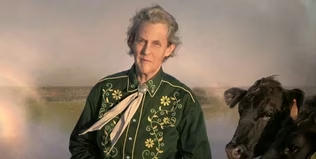
A conversation with renowned animal scientist Temple Grandin
Video has Closed Captions
Clip: 12/20/2025 | 9m 36s | A conversation with Temple Grandin, world-renowned animal scientist and autism advocate (9m 36s)
DOJ’s heavily redacted Epstein file release draws criticism
Video has Closed Captions
Clip: 12/20/2025 | 5m 32s | Justice Department’s heavily redacted Epstein file release draws criticism from lawmakers (5m 32s)

How retailers are using AI and personal data to set prices
Video has Closed Captions
Clip: 12/20/2025 | 5m 52s | How online retailers are using AI to adjust prices by mining your personal data (5m 52s)

News Wrap: Russia continues Ukraine strikes amid peace talks
Video has Closed Captions
Clip: 12/20/2025 | 2m 53s | News Wrap: Russian offensive drags on in Ukraine amid ceasefire talks (2m 53s)
Providing Support for PBS.org
Learn Moreabout PBS online sponsorship
- News and Public Affairs

FRONTLINE is investigative journalism that questions, explains and changes our world.

- News and Public Affairs

Amanpour and Company features conversations with leaders and decision makers.












Support for PBS provided by:
Major corporate funding for the PBS News Hour is provided by BDO, BNSF, Consumer Cellular, American Cruise Lines, and Raymond James. Funding for the PBS NewsHour Weekend is provided by...