
Arizona Yuma Winter Lettuce
Clip: 4/13/2026 | 4m 44sVideo has Closed Captions
Farmers harvest lots and lots of lettuce from America's winter salad bowl in Arizona.
“Heads will roll” in this southwestern farm field…as farmers harvest lots and lots of lettuce from America’s winter salad bowl.
Problems playing video? | Closed Captioning Feedback
Problems playing video? | Closed Captioning Feedback
America's Heartland is presented by your local public television station.
Funding for America’s Heartland is provided by US Soy, Sustainable Agriculture Research and Education, Rural Development Partners, and a Specialty Crop Grant from the California Department of Food and Agriculture.
Arizona Yuma Winter Lettuce
Clip: 4/13/2026 | 4m 44sVideo has Closed Captions
“Heads will roll” in this southwestern farm field…as farmers harvest lots and lots of lettuce from America’s winter salad bowl.
Problems playing video? | Closed Captioning Feedback
How to Watch America's Heartland
America's Heartland is available to stream on pbs.org and the free PBS App, available on iPhone, Apple TV, Android TV, Android smartphones, Amazon Fire TV, Amazon Fire Tablet, Roku, Samsung Smart TV, and Vizio.
Providing Support for PBS.org
Learn Moreabout PBS online sponsorshipWe're going to do a little coast to coast traveling and spend some time in the Great Plains as well.
And we're going to pick a little produce to get us going.
We'd all love to get VERY fresh vegetables from our own gardens, but that's not always practical and almost impossible when the snow is flying in those winter months.
But, winter is the prime growing season for lettuce in one part of the heartland.
♪♪ >> Great in salads, lettuce is one of the most popular vegetables at your supermarket.
American farmers will produce one quarter of the lettuce grown on earth.
But the green and leafy favorite is highly perishable - which means the challenge for growers is to pick it, pack it and get it to consumers.
>> I would say millions of people have eaten ours and our neighbor's lettuce grown in this area.
>> The average American will consumer about 30 pounds of lettuce each year.
Much of it comes from these fields near Yuma, Arizona.
>> We produce this product as a collective and we all have pride in it.
We want the market to have a good reputation.
>> On this late February afternoon, farm workers spread across the fields to harvest different kinds of lettuce from iceberg to romaine.
>> How soon will this be to a consumer?
Will this be on someone's table?
>> Two days to two weeks, depending on where you're at in the US or Canada.
>> You service some of the largest fast food chains in the country.
>> There's a bunch of growers here in Yuma that produce for companies that supply all of those large restaurant chains with consistent product throughout the year, day in and day out, year round.
This area here in Yuma is a, salad is big business here.
>> That's what we're looking for.
>> Yeah, looks gorgeous.
>> Kent Inglett and John Boelts farm three thousand acres of land in southwest Arizona and... >> These days, farmers must look beyond picking and packing to meet consumer demand.
In the lettuce game, presentation and preparation are also important.
>> The way that it's handled in the field for use in Romaine hearts later on is, they'll take and take the bottom off, which we call tailing, and they'll take the top off, which the crews are a lot better at it than I am.
>> They do this in the field?
>> Then they'll drop the outside leaves.
And that's what you're left with, which is a heart of Romaine.
>> It's beautiful.
>> And what the customer's looking for, when you're all finished doing all that, when it goes through processing.
>> Oh look, there it is.
>> They're looking for the two different colors of lettuce, so you have a nice color contrast on your plate when you're serving.
>> There's your Caesar salad.
>> John and Kent credit their contract workers for helping to make the business successful.
Many in these fields are Mexican citizens who commute into the U.S.
daily to bring in the year round harvests.
>> You know, hands on stuff that people do, it's a true craftsmanship trade.
And to do what some of the folks on our crews do, or some of our tractor drivers or irrigators do, a lot of people talk about ag labor not being skilled.
Whether you're driving a combine in the Midwest harvesting grain, or you're cutting lettuce and trucking it to market, it's highly skilled labor.
>> Come on, it's picnic time!
Come on Daisy!
Come on kids!
>> A midday meal here often means lunch alongside the fields.
>> This is Romaine lettuce that we just harvested about an hour ago from there.
>> What's your favorite food?
>> Lettuce >> And why is lettuce your favorite food?
>> Because daddy grows it!
>> What does it mean to you to know that you guys really are supplying a product to the entire country?
>> I think it gives you a sense of pride that you're producing not just a product, but something that helps people grow and helps families and is healthy for families as well.
It gives you a sense of knowing that it's worthwhile.
John does work a lot of hours being a farmer, but it is something worthwhile.
>> John and Kent don't know yet if their youngsters will be "a next generation of farmers."
What they do know is that their fields of green have become their fields of dreams.
>> The lifestyle it affords me.
We do work a lot of hours but we can spend a lot more time with our family.
It's more a traditional way of life for us and that's just the way I choose to live my life.
>> If "iceberg" lettuce is on your salad plate, you may be interested to know that before the 1920's "iceberg" was better known as "crisp head" lettuce.
The name change came when the round heads of lettuce were covered with crushed ice for shipping to eastern markets.
 New
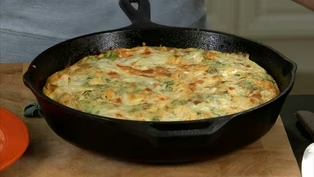
NewFarm to Fork Cauliflower Frittata
Video has Closed Captions
On Farm to Fork, we’ll learn how to prepare a frittata made with cauliflower. (6m 36s)
 New
NewVideo has Closed Captions
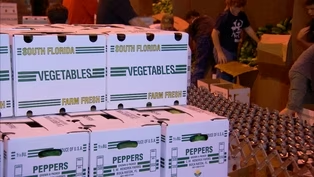
Growers down south step up efforts to help the hungry as part of “Farmers Feed Florida.” (6m 24s)
 New
NewVideo has Closed Captions
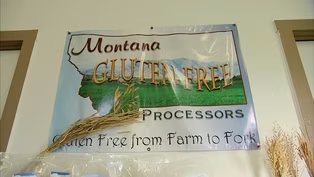
Montana farmers cash in on a growing demand for gluten free farm crops. (4m 48s)
Providing Support for PBS.org
Learn Moreabout PBS online sponsorship
- Food
Christopher Kimball’s Milk Street Television
Transform home cooking with the editors of Christopher Kimball’s Milk Street Magazine.











Support for PBS provided by:
America's Heartland is presented by your local public television station.
Funding for America’s Heartland is provided by US Soy, Sustainable Agriculture Research and Education, Rural Development Partners, and a Specialty Crop Grant from the California Department of Food and Agriculture.