Virginia Home Grown
Orchard Tree Pruning
Clip: Season 26 Episode 1 | 3m 33sVideo has Closed Captions
Increase blossoms and get a bigger harvest by properly pruning fruit trees
Amyrose Foll explains pruning techniques for fruit trees to yield a more bountiful harvest. Featured on VHG episode 2601, March 2026.
Problems playing video? | Closed Captioning Feedback
Problems playing video? | Closed Captioning Feedback
Virginia Home Grown is a local public television program presented by VPM
Virginia Home Grown
Orchard Tree Pruning
Clip: Season 26 Episode 1 | 3m 33sVideo has Closed Captions
Amyrose Foll explains pruning techniques for fruit trees to yield a more bountiful harvest. Featured on VHG episode 2601, March 2026.
Problems playing video? | Closed Captioning Feedback
How to Watch Virginia Home Grown
Virginia Home Grown is available to stream on pbs.org and the free PBS App, available on iPhone, Apple TV, Android TV, Android smartphones, Amazon Fire TV, Amazon Fire Tablet, Roku, Samsung Smart TV, and Vizio.
Providing Support for PBS.org
Learn Moreabout PBS online sponsorship(bright percussive music) >>There's many different methods and schools of thought on pruning.
We're gonna be talking about orchard trees.
This particular tree is an apple tree, and what we're doing today is a late winter, early spring pruning.
You want to ideally do that between February and March every year while the trees are still dormant.
And what you're going to do is encourage blooms early in the spring, and in turn, you'll get a bountiful harvest.
What we're doing today is going to be removing the three Ds, dead, damaged, and diseased wood.
And we're gonna be taking off suckers and water sprouts as well.
These little guys down here are below four feet in height, so we're gonna be removing everything below that.
You wanna make sure your tools are clean and sharp so that you're not introducing disease into the tree.
And everything comes off fairly easily.
You're basically just clearing everything from four feet down.
And you don't want to do this with trees that are too young.
Give them a few years to get established first.
We had a flood last year, or two years ago, and these actually fell all the way over, so we staked them.
The stakes will come out, you don't ever wanna leave a brace in for too long because when you remove it, if you leave it for too long, you can damage the roots.
And so we're gonna be taking all of these morning glories out.
If you have other things like Virginia creeper or trumpet vine around your tree, remove those, you don't want them to strangle your tree.
And then as you work your way up, the more horizontal branches, that's what we're gonna keep, because eventually, as you're shaping your tree over a few years, you want those horizontal branches to be fruit-bearing.
So what you're gonna do is you're gonna identify your horizontal branches and run your hand along the bottom of each one of those and remove everything that's growing down or everything that's growing straight up.
This guy will come off.
We'll remove these.
And then that's pretty good, and this guy is pretty good.
You're gonna wanna open up this canopy in the center.
We have three main branches here.
This would be our central leader, it's the most vertical, and that's gonna control the tree growth.
But as you see, there's these branches in the center, we wanna remove those as well.
Anything growing into the center of the canopy, you wanna remove because we want to increase air circulation and light harvesting.
So we want the light to penetrate into the canopy of the tree.
It may seem a little harsh, but you'll thank yourself later in the season.
These branches growing out, they will eventually start to droop farther, and that's great.
We want them to be about horizontal when the tree is fully mature and producing fruit.
The best thing you can do is don't overcomplicate it.
When you are pruning, keep in mind the three Ds, dead, diseased, and damaged branches, removing all of those.
And then make sure that you are pruning with capturing light and air circulation in mind.
You'll have great spring blooms and you'll have a bountiful harvest in the fall.
(turkeys gobbling)
 New
NewVideo has Closed Captions
Clip: S26 Ep1 | 7m 57s | Learn about edible flowers and garnishes used to decorate cakes (7m 57s)
 New
NewVideo has Closed Captions
Clip: S26 Ep1 | 7m 59s | Learn how cut flowers are grown locally using sustainable methods (7m 59s)
 New
NewVideo has Closed Captions
Clip: S26 Ep1 | 3m 1s | Divide and transplant perennial flowers to fill your garden with color (3m 1s)
 New
NewVideo has Closed Captions
Clip: S26 Ep1 | 6m 4s | Learn tips to keep your garden tools sharp and clean (6m 4s)
 New
NewVideo has Closed Captions
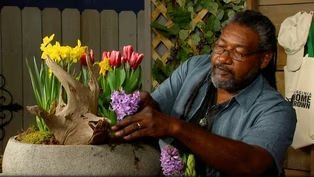
Clip: S26 Ep1 | 6m 54s | Learn how to make an easy spring planter using potted perennials (6m 54s)
Providing Support for PBS.org
Learn Moreabout PBS online sponsorship

- Home and How To

Hit the road in a classic car for a tour through Great Britain with two antiques experts.












Support for PBS provided by:
Virginia Home Grown is a local public television program presented by VPM