
How Strong Was a T. Rex Bite? | Wild Critters USA
Special | 34m 20sVideo has Closed Captions
T. rex had a bone-exploding bite and tiny arms! Travel back 66 million years on Wild Critters.
The T. rex had a bone-crushing bite, ridiculously tiny arms, and a very big problem 66 million years ago! In this episode of the Wild Critters series on Orbit, families travel back in time with Dr. Roger Benson from the American Museum of Natural History. Perfect for curious kids ages 3 to 11 and their families.
Problems playing video? | Closed Captioning Feedback
Problems playing video? | Closed Captioning Feedback
Major support for NATURE is provided by The Arnhold Family in memory of Henry and Clarisse Arnhold, Sue and Edgar Wachenheim III, The Fairweather Foundation, Charles Rosenblum, Kathy Chiao and...
How Strong Was a T. Rex Bite? | Wild Critters USA
Special | 34m 20sVideo has Closed Captions
The T. rex had a bone-crushing bite, ridiculously tiny arms, and a very big problem 66 million years ago! In this episode of the Wild Critters series on Orbit, families travel back in time with Dr. Roger Benson from the American Museum of Natural History. Perfect for curious kids ages 3 to 11 and their families.
Problems playing video? | Closed Captioning Feedback
Where to Watch Nature
Nature is available to stream on pbs.org and the PBS app.
Buy Now
Explore More Ways to Watch
Bring the beauty and wonders of wildlife and natural history into your home with classic NATURE episodes.Providing Support for PBS.org
Learn Moreabout PBS online sponsorshipMore from This Collection
To celebrate America's 250th anniversary, PBS Nature is teaming up with Orbit: Science for Kids on the Move! and National Wildlife Federation's Ranger Rick to bring you stories of creatures from around the United States.
Sea Otters: Superheroes for Kelp Forests | Wild Critters USA
Video has Closed Captions
Sea otters aren't just cute, they're guardians of an entire underwater forest. (31m 52s)
The Race To Save Three Mountain Lion Cubs | Wild Critters USA
Video has Closed Captions
Three orphaned mountain lion cubs and one epic rescue mission. Join us on Wild Critters! (28m 10s)
How Tiny Corals Build Underwater Cities | Wild Critters USA
Video has Closed Captions
Kids discover coral reefs on this Wild Critters episode with the Smithsonian. (31m 13s)
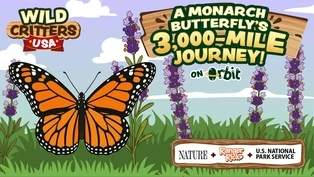
A Monarch Butterfly’s 3,000-Mile Journey | Wild Critters USA
Video has Closed Captions
Follow the monarch butterfly's incredible 3,000-mile migration to Mexico. (29m 9s)
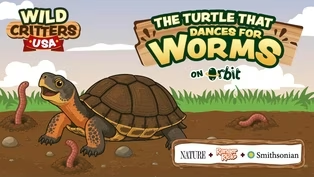
The Turtle that Dances for Worms | Wild Critters USA
Video has Closed Captions
Meet Wanda, the wood turtle who dances to trick worms out of the ground. (25m 47s)
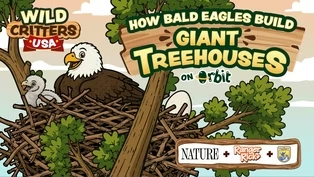
How Do Baby Bald Eagles Learn To Fly? | Wild Critters USA
Video has Closed Captions
Discover how bald eagles build giant nests and learn to fly! (27m 16s)
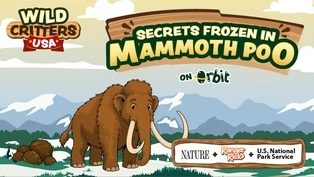
Ice Age Secrets Frozen in Mammoth Poo | Wild Critters USA
Video has Closed Captions
Discover mummified mammoth poop and the Ice Age secrets it holds. (29m)
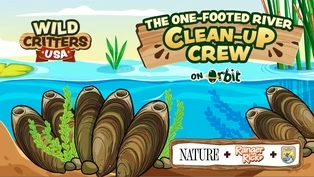
Meet Nature's Water Cleaners | Wild Critters USA
Video has Closed Captions
Discover how tiny freshwater mussels keep streams healthy! (27m 29s)
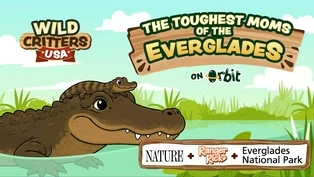
The Toughest Moms of the Florida Everglades | Wild Critters USA
Video has Closed Captions
Discover the amazing American alligator and the wetlands of the Florida Everglades. (27m 28s)
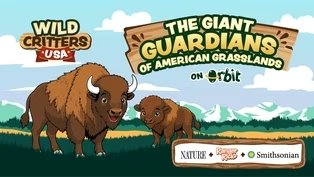
The Fluffy Guardians of American Grasslands | Wild Critters USA
Video has Closed Captions
Families discover America's largest mammal with Orbit, PBS Nature and the Smithsonian. (30m 4s)
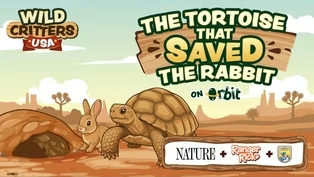
The Tortoise that Saved the Rabbit | Wild Critters USA
Video has Closed Captions
Discover the incredible Mojave desert tortoise on this family episode of Wild Critters. (27m 16s)
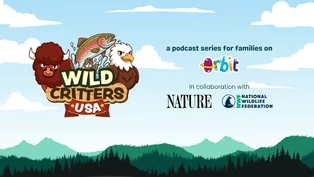
Official Trailer | Wild Critters USA
Video has Closed Captions
Explore amazing American wildlife and outdoors in this family podcast series! For kids ages 3-11. (1m 11s)
Providing Support for PBS.org
Learn Moreabout PBS online sponsorshipChild This episode is part of the Wild Critters USA series, a collaboration with Orby, PBS Nature, and the National Wildlife Federation.
Rob Hey, Hank.
Rob Remember when you and I went to the American Museum of Natural History?
Rob Exactly.
Rob The one with all the dinosaur bones.
Rob I honestly can't stop thinking about all the dinosaurs.
Rob Can you imagine what the world must have been like back then?
Rob Giant, long-neck dinosaurs eating the tops of trees.
Rob Massive crocodiles.
Rob Giant flying dinosaurs.
Rob Frogs croaking in the swamps.
Rob And of course, huge reptile monsters stomping around, shaking the ground with every step.
Rob But the thing that really has my heart racing?
Rob Exactly.
Rob Turning around a corner and seeing a huge, hungry, I mean really ginormous T-Rex.
Rob That T-Rex fossil that we saw at the museum was enormous.
Rob Taller than our house.
Rob There's something I keep thinking about though.
Rob No, not the snacks we ate at the park after.
Rob It was the T-Rex 's arms.
Rob They were... Rob really small.
Rob ridiculously small compared to the rest of its body.
Rob I know, Hank.
Rob It's not a good idea to make fun of apex predators.
Rob I was just surprised.
Rob I kept thinking, if that thing really tried to give me a high five, it probably couldn't even reach my hand.
Rob So T-Rex was the most fearsome predator to ever live, and at the exact same time, the world's worst high fiber.
Rob But I wonder why its arms are like that.
Rob Hey, Orbiters.
Rob Today we're learning about the incredible Tyrannosaurus Rex.
Rob Some of you, Orbiters, are just as excited as I am.
Child What's the earth like when T-Rexes lived?
Child How do we know if T-Rex is a bird or reptile?
Child Why did the T-Rex go extinct?
Rob And to help us out, we found an incredible expert.
Rob His name is Dr.
Rob Roger, and he's the curator of dinosaurs at the American Museum of Natural History.
Rob Welcome to Orbit, Dr.
Rob Roger.
Dr.
Roger Benson, AMNH Hi Orbiters.
Dr.
Roger Benson, AMNH I'm Dr.
Dr.
Roger Benson, AMNH Roger Benson, and I'm curator of dinosaurs at the American Museum of Natural History in New York.
Dr.
Roger Benson, AMNH So I'm A paleontologist, and my job is to discover new fossils, and by studying those fossils, understand things about life in the past.
Rob And what were you like as a kid, Dr.
Rob Roger.
Dr.
Roger Benson, AMNH So I was always a little tall for my age, and I loved nature.
Dr.
Roger Benson, AMNH I spent a lot of time digging in the dirt to find things like worms, catching insects, and things like that.
Dr.
Roger Benson, AMNH I'm pretty sure I learned the name of every dinosaur by the time I was 10 years old.
Rob That is so cool.
Rob You followed your curiosity all the way to being a dinosaur scientist.
Rob All right, Orbiters, buckle up.
Rob This is going to be a very wild ride.
Rob Hey parents, this is our last episode in the Wild Critter series.
Rob If you've enjoyed learning about wildlife, can you leave us a review and comment on Apple Podcasts to let us know?
Rob Your reviews help us see what our audiences want to learn about, and they're super important for us when we invite episode guests so that we can keep bringing the best scientists in the world to families like yours.
Rob Thank you.
Rob All right, who's ready to get started?
Rob Dr.
Rob Roger, what exactly was the T-Rex?
Dr.
Roger Benson, AMNH The full name of this animal is Tyrannosaurus Rex, and it is a giant meat-eating dinosaur that lived in North America around 70 million years ago.
Dr.
Roger Benson, AMNH That's a really long time.
Rob You can say that again.
Rob I can't even imagine 70 million years.
Rob Tyrannosaurus rex is kind of a crazy name.
Rob We want to learn more about it.
Child Hi, Orbit.
Child My name is Nicolas and I live in Mexico.
Child And my question is, why is its name T-Rex?
Child Thank you.
Child Hi, my name is Luna.
Child I'm 6 years old and I live in New York.
Child And my question is, how did the T-Rex get its name?
Dr.
Roger Benson, AMNH Thanks, Orbiters.
Dr.
Roger Benson, AMNH That's a really great question.
Dr.
Roger Benson, AMNH The Tyrannosaurus part means tyrant lizard.
Dr.
Roger Benson, AMNH and rex means king.
Dr.
Roger Benson, AMNH Now, because T-Rex is a dinosaur and not a lizard, I like to say tyrant reptile instead of tyrant lizard.
Dr.
Roger Benson, AMNH And A tyrant is someone like an emperor or a very strict leader who everyone just has to do what they say.
Rob Well, that sounds familiar.
Rob I bet some orbiters have older siblings who act like tyrants sometimes.
Dr.
Roger Benson, AMNH And you know, T-Rex was the biggest land predator that we've ever found, so you had to do what it said.
Rob If a T-Rex told me to do something, I would just nod my head and do it.
Rob Like take a bath, or clean under my bed, or put up my dirty laundry, or eat a smelly sock.
Rob You're right, Hank.
Rob Maybe not the smelly sock thing.
Rob You have to draw the line somewhere.
Child Hello, my name is Josh and I'm 4 1/2 years old.
Child And my question is, how big was T-Rex?
Rob Hey Orbiters, let's practice forming a hypothesis.
Rob How long do you think a T-Rex was?
Rob From its nose to the tip of its tail.
Rob Was it A, as long as your bed.
Rob B, as long as a school bus.
Rob Or C, as long as a football field.
Rob Shout out your hypothesis.
Rob Okay, Dr.
Rob Roger, how big was the T-Rex?
Dr.
Roger Benson, AMNH Thanks, Josh.
Dr.
Roger Benson, AMNH T-Rex weighed 7 tons, so that's really, really heavy.
Dr.
Roger Benson, AMNH It's about 15,000 pounds, and that's a little bigger than the biggest elephants alive today.
Rob Wowzers!
15,000 pounds?
Rob That's about 85 of me, or 187 Hanks.
Rob I know Hank.
Rob It probably needed extra large doggy snacks.
Dr.
Roger Benson, AMNH But it walked on two legs, where elephants walk on four legs, and it was about 12 meters long, which is about as long as a yellow school bus.
Rob A T-Rex would be the scariest school bus of all time.
Rob Hey, let's get to some super interesting questions from our friends, Kabir and Kenji.
Child Hello, my name is Kabir and I'm 6 years old and I'm in Washington DC.
Child And my question is, why do T-Rexes have small arms?
Child Bye.
Child Hi, my name is Kenji.
Child I'm 6 years old.
Child And my question is, why do T-Rexes have small arms and big legs?
Child Were they good runners?
Dr.
Roger Benson, AMNH Thanks, Orbiters.
Dr.
Roger Benson, AMNH T-Rex has really small arms and it's got big sturdy legs.
Dr.
Roger Benson, AMNH That's because this is a really heavy animal.
Dr.
Roger Benson, AMNH So imagine trying to support the weight of a whole elephant just on two legs.
Dr.
Roger Benson, AMNH but it doesn't need long arms because the arms aren't used in walking.
Rob So no handstands for the T-Rex.
Dr.
Roger Benson, AMNH Although some other dinosaurs used their arms to do things like get food from the environment or fight other dinosaurs, we don't think T-Rex was really doing that.
Dr.
Roger Benson, AMNH So because the arms aren't particularly used in fighting and they're not used in walking, T-Rex had much smaller arms than you'd expect.
Dr.
Roger Benson, AMNH So its arms were about the same size as my arms.
Dr.
Roger Benson, AMNH And this is basically telling us that T-Rex just didn't use its arms that much.
Rob There's an important concept in there, orbiters.
Rob In nature, an animal's body often matches the job it needs to do.
Rob Scientists sometimes call this form follows function.
Rob For example, a giraffe has a long neck, not just to have a long neck.
Rob It's shaped just right for reaching leaves way up high.
Rob And a duck has webbed feet, shaped kind of like paddles, which are perfect for swimming.
Rob And A T-Rex's legs were huge and strong because they had a big job, carrying around its whole heavy body.
Rob But its arms didn't have an important job to do.
Rob So they just stayed small.
Rob Hey, Dr.
Rob Roger, was the T-Rex fast.
Dr.
Roger Benson, AMNH You also asked whether it was a good runner.
Dr.
Roger Benson, AMNH Now that is a really fascinating question.
Dr.
Roger Benson, AMNH We think that T-Rex could run about 18 miles an hour, and that's a little slower than Dr.
Roger Benson, AMNH the fastest human sprinters.
Dr.
Roger Benson, AMNH So the good news is, if you were really fast at running, then T-Rex wouldn't be able to catch you.
Dr.
Roger Benson, AMNH But if you're a little slow, it's possible that T-Rex could get you.
Rob I know, Hank.
Rob We need to start practicing running fast, just in case we see a T-Rex sometime.
Rob Hey, Dr.
Rob Roger, what about the T-Rex's head?
Dr.
Roger Benson, AMNH When we look at T-Rex, it has a giant head, and that giant head is full of these giant teeth.
Dr.
Roger Benson, AMNH And the combination of the giant teeth and the giant head and the shapes of the teeth that look a little bit like steak knives tell us that it's a meat-eating dinosaur.
Dr.
Roger Benson, AMNH Scientists have argued about whether it actually could hunt its prey or whether it was just a scavenger, so eating dead animals that it found in the environment.
Dr.
Roger Benson, AMNH These days, most scientists think that T-Rex would have been capable of hunting prey, but the prey would have been other fairly big dinosaurs that also moved quite slowly.
Rob We'll learn more about some of its favorite foods Rob But first, a question from our friend Remy, who's a mega super fan of T-Rexes.
Child Hello, my name is Remy.
Child I'm 6 years old.
Child I'm from Canada.
Child And my question is, how strong is a T-Rex bite?
Dr.
Roger Benson, AMNH Oh, that's a good question, Remy.
Dr.
Roger Benson, AMNH T-Rex could bite very, very hard, possibly harder than any other animal that ever lived on land.
Dr.
Roger Benson, AMNH Scientists think it could bite around 6,000 pounds of force.
Rob Pounds of force is just the way scientists measure how hard something pushes or squeezes.
Rob To put a T-Rex bite into perspective, if you or I bit down as hard as we possibly could, Rob is around 150 pounds of force.
Rob So a T-Rex was 40 times more powerful.
Dr.
Roger Benson, AMNH That's so much force that it's actually hard for us to imagine what it's like, but it's strong enough to very quickly shatter large bones.
Dr.
Roger Benson, AMNH So imagine if you had the bone of an elephant or a cow.
Dr.
Roger Benson, AMNH T-Rex could easily pulverize those bones into splinters by biting down on it.
Dr.
Roger Benson, AMNH In fact, the force of T-Rex bite is so strong that when scientists have applied those forces to bones in the laboratory, the bones more or less literally explode with force.
Rob You can't see us, but Hank and I are just sitting here with our mouths open, staring at each other in disbelief.
Rob A T-Rex bite could explode a cow bone?
Rob Kind of like when I bite into a potato chip really hard and crumbs go everywhere.
Rob Okay, Remy, keep rolling with the questions.
Child Hello, my name is Remy.
Child I'm 6 years old and I'm from Canada.
Child I'm curious if a T-Rex will eat a stegosaurus or a triceratops.
Rob Hank and I agree this is a very important question.
Rob Because when I play with dinosaurs in my room, I often have my T-Rex and then a stegosaurus and a triceratops.
Rob A stegosaurus.
Rob is a big four-legged dinosaur that has armored plates on its back and spikes on its tail to defend itself.
Rob And A triceratops is another big four-legged dinosaur with three huge horns coming out of its head and a big armored plate protecting its neck.
Rob They were both giant herbivores, which means they ate plants.
Rob Okay, Doctor.
Rob Roger.
Rob When I'm flying with my dinosaurs, should I pretend the T-Rex is trying to eat the Stegosaurus or the Triceratops?
Dr.
Roger Benson, AMNH Thanks, Remy.
Dr.
Roger Benson, AMNH T-Rex ate meat.
Dr.
Roger Benson, AMNH And actually, I think it basically would have eaten anything it could get its hands on.
Dr.
Roger Benson, AMNH So Triceratops lived at the same time as T-Rex in the same place in North America.
Dr.
Roger Benson, AMNH So they lived together.
Dr.
Roger Benson, AMNH And it's very likely then that T-Rex ate Triceratops sometimes.
Rob Wow.
Rob So did the T-Rex choose the biggest, meanest Triceratops to eat?
Dr.
Roger Benson, AMNH When we watch what they actually do, they generally don't hunt the biggest, healthiest adults.
Dr.
Roger Benson, AMNH They normally hunt weak individuals or young individuals or individuals that are going to be less good at defending themselves.
Dr.
Roger Benson, AMNH So T-Rex, if it went after Triceratops, it probably went after smaller or weaker Triceratopses.
Rob And what about the Stegosaurus?
Rob Did the T-Rex also like to eat Stegosauruses too?
Dr.
Roger Benson, AMNH Now, T-Rex and Triceratops lived about 70 million years ago.
Dr.
Roger Benson, AMNH Stegosaurus actually lived way before that, about 150 million years ago.
Rob These numbers are kind of hard for me.
Rob 70 million years ago is a long time ago.
Rob And 150 million years ago is also a long time ago.
Rob But what Dr.
Rob Roger is saying is that there's a really big difference between those numbers.
Rob So even though they're both dinosaurs, the T-Rex and the Stegosaurus didn't actually live at the same time.
Dr.
Roger Benson, AMNH One way to think about this is when T-Rex was alive, Stegosaurus was already a fossil.
Rob I kind of like to imagine a bunch of T-Rex families Rob walking around in a museum looking at fossils of stegosauruses.
Dr.
Roger Benson, AMNH So T-Rex never would have met a living stegosaurus, so it wouldn't have eaten it, but it could have eaten triceratops, and it could have eaten duck-billed dinosaurs, the hadrosaurs like Edmontosaurus that were also alive at the same time.
Rob Let's get to a couple fascinating questions.
Child Hey Orbiters, I'm called Max.
Child I live in Seville and my question is, how do we know if T-Rex is a bird or reptile?
Child Hello, my name is Remy.
Child I'm 6 years old and I'm from Canada.
Child And my question is, does T-Rex have any feathers?
Rob I've heard about flying dinosaurs and about dinosaurs that had feathers, but Rob thought that T-Rex might have feathers.
Rob Hey, Dr.
Rob Roger, can you teach us?
Dr.
Roger Benson, AMNH Thanks, Orbiters.
Dr.
Roger Benson, AMNH I love this question.
Dr.
Roger Benson, AMNH It's a really interesting one because although they seem very different to other reptiles, like lizards or crocodiles or turtles, birds are a type of reptile.
Dr.
Roger Benson, AMNH And what that means is they share an ancestor with other reptiles.
Rob Sharing an ancestor means they have the same great, great, great, great, great, great, great, great, great, great, great, great, great grandparent.
Rob Way, way, way, way, way, way back in time.
Rob Birds, lizards, crocodiles, and turtles are like one giant family of cousins, all descended from the same very, very, very old reptile.
Dr.
Roger Benson, AMNH Now that ancestor lived a very long time ago, so maybe around 300 million years ago.
Dr.
Roger Benson, AMNH But also did you know that birds are dinosaurs?
Dr.
Roger Benson, AMNH So dinosaurs are a type of reptile and birds are a type of dinosaur.
Dr.
Roger Benson, AMNH This is very exciting because it means we live with dinosaurs today.
Rob Hank, do you know what that means?
Rob No, not quite.
Rob You're getting closer.
Rob Yes, exactly.
Rob It means that chicken nuggets are actually dinosaur Rob nuggets.
Rob This is the most exciting news I've had all day.
Dr.
Roger Benson, AMNH So one of the things that's special about birds is they happen to be the only dinosaurs that survived to the present day.
Dr.
Roger Benson, AMNH And T-Rex is actually a fairly close relative of birds, but it's not a bird.
Dr.
Roger Benson, AMNH We don't have evidence that T-Rex had feathers, but we have fossils of other dinosaurs that are close relatives of T-Rex.
Dr.
Roger Benson, AMNH They include a Chinese dinosaur called Yutyrannus.
Dr.
Roger Benson, AMNH And Yutyrannus is an exciting fossil discovery because the Dr.
Roger Benson, AMNH the fossilized skin and a covering of fur-like structures that are quite similar to feathers and that we call proto-feathers.
Rob That's a fun word, orbiters.
Rob Proto-feathers.
Rob Do you know what feathers are, Orbiters?
Rob Feathers are light, strong coverings that grow out of a bird's skin, made from a protein called keratin, the same kind of protein that's in your hair and fingernails.
Rob They're specially designed to help birds fly, stay warm, and even show off.
Rob Well, feathers didn't just appear out of thin air.
Rob They gradually evolved over time.
Rob Dr.
Rob Roger is saying that this other dinosaur had proto-feathers, which was probably an early step Rob Evolution of modern feathers that.
Rob that birds have today.
Rob Hey, Dr.
Rob Roger, how old could T-Rexes be?
Dr.
Roger Benson, AMNH Do you know that when we cut open dinosaur bones, we find inside structures a little bit like tree rings that record how many years the dinosaur was growing for?
Dr.
Roger Benson, AMNH And from these structures in T-Rex, we know that actually it wasn't growing for hundreds of years, it was growing for about 30 years.
Dr.
Roger Benson, AMNH So T-Rex was growing pretty quickly, similar to a living mammal like an elephant.
Rob And where did these T-Rexes live?
Dr.
Roger Benson, AMNH So T-Rex Dr.
Roger Benson, AMNH in North America, and it belongs to a group of dinosaurs called Tyrannosaurs.
Dr.
Roger Benson, AMNH They live across North America, Asia, Europe, and possibly in the Southern Hemisphere.
Rob Hey Orbiters, we'll talk more about this in a little bit.
Rob But T-Rex fossils have been discovered in the western United States and Canada, including states like Montana, Wyoming, and New Mexico in the United States, and in Alberta, Canada.
Rob Hey Orbiters, who's ready for a mystery sound?
Rob You can move around and wiggle while you listen and think about what the sound is.
Rob Think you got it?
Rob Here's a hint.
Rob It's an animal found in Africa.
Rob Stick around to the end for the answer.
Rob Okay, let's get back to more questions.
Child My name's Junia.
Child I'm 3 years old.
Child I live in Illinois Springfield.
Child And my question is, what was the Earth like when T-Rexes lived?
Dr.
Roger Benson, AMNH Thanks, Junie.
Dr.
Roger Benson, AMNH I really love this question.
Dr.
Roger Benson, AMNH So T-Rex lived around 70 million years ago.
Dr.
Roger Benson, AMNH We have fossils from T-Rex up to about 66 million years ago.
Dr.
Roger Benson, AMNH So for several million years, we find their fossils in North America.
Dr.
Roger Benson, AMNH And it's good to sort of imagine what it was like Dr.
Roger Benson, AMNH in North America 70 million years ago at the time of T-Rex.
Rob Orbiters, put your imagination caps on.
Rob Let's hop in the orbiter time machine and go back 70 million years.
Rob Hank, why don't you sit this one out?
Rob There's some big scary dinosaurs out there.
Rob Okay, three, two, one, here we go.
Rob Whoa!
Hey there, orbiters!
We're here in the Cretaceous period, walking around through a wild, swampy forest.
Rob What do you see?
Rob Are there insects?
Rob Flying dinosaurs?
Rob Hey, Dr.
Rob Roger, can you describe it for us?
Dr.
Roger Benson, AMNH It was warmer than today, and that's because the whole Earth was a little warmer.
Dr.
Roger Benson, AMNH So if you go to the North Pole or the South Pole, you'll find it's very cold and there's lots of snow and ice.
Dr.
Roger Benson, AMNH But in the times of T-Rex, there was very little ice on Earth.
Rob Now that you mention it, is really hot.
Rob I am covered in sweat.
Dr.
Roger Benson, AMNH So you'd have to not just go to the North or South Pole, but also maybe go up a mountain to find ice.
Dr.
Roger Benson, AMNH It lived in an environment that had forests, but not thick forests.
Dr.
Roger Benson, AMNH Forests were a little different back then to how they are today.
Dr.
Roger Benson, AMNH So things like pine trees and ginkgos, which you might know about, were more common.
Rob So orbiters, if you're looking around in this T-Rex forest, you see tall pine trees, but no oak trees dropping acorns, and no maple trees with bright red leaves in the fall.
Rob That's because they haven't evolved yet.
Rob Oaks and maples wouldn't show up until millions of years after the T-Rex.
Dr.
Roger Benson, AMNH And many of the types of trees that are important today didn't even exist.
Dr.
Roger Benson, AMNH It would have been similar to walking through a pine forest.
Dr.
Roger Benson, AMNH It lived in an environment with many other animals.
Rob Look over there, orbiters.
Rob It's one of those three-horned dinosaurs that T-Rexes like to eat.
Rob And over there, there's a family of funny-looking dinosaurs.
Rob They kind of look like they have a beak like a duck.
Dr.
Roger Benson, AMNH That includes dinosaurs that you might have heard of, like Triceratops and the duck-billed dinosaurs like Edmontosaurus.
Rob Are there really big predators other than the T-Rex that we need to watch out for here, Dr.
Rob Roger.
Dr.
Roger Benson, AMNH T-Rex was the biggest predator in that environment, but there were other predators, like the smaller Tyrannosaur, Nanotyrannus, that lived alongside it.
Dr.
Roger Benson, AMNH And they weren't just dinosaurs, there were also lots of other animals that would be familiar to us today.
Dr.
Roger Benson, AMNH So that includes birds.
Dr.
Roger Benson, AMNH There would have been lots of birds in the trees singing and flying around.
Dr.
Roger Benson, AMNH If you looked closely at them, they would have looked very strange to you because inside the mouths of those birds, they didn't have beaks, but some of them would have had teeth.
Rob Wait, birds with big teeth?
Rob That might be even scarier than a T-Rex.
Dr.
Roger Benson, AMNH There were also animals like turtles and frogs.
Rob Okay, now that we know what forests were like, what about the water?
Dr.
Roger Benson, AMNH And in the oceans, life was also different, and one of the biggest differences to you or me would have been that there were no whales and dolphins, but there were sharks, and there were also giant ocean-going reptiles.
Dr.
Roger Benson, AMNH Things like mosasaurs, and it's good to think of them as giant lizards that are being predators like killer whales in the ocean.
Dr.
Roger Benson, AMNH So there was a mixture of strange, unfamiliar creatures like dinosaurs, but also animals that we see today.
Rob Hey, Dr.
Rob Roger, this world sounds really amazing, but a bunch of orbiters have a really important question.
Child Hi, I'm Samantha from Child Costa Rica.
Child I'm 7 years old.
Child My question is, why did that T-Rex go extinct?
Child Bye.
Child My name's Wendell.
Child I live in... Child I live in Illinois.
Child I'm five years old.
Child And my question is, why did the T-Rex go extinct?
Child Hi, my name is Victoria.
Child I'm five years old.
Child I live in Atlanta, Georgia.
Child My question is, why did T-Rexes die?
Child Bye, audio listeners and Rob.
Rob Do you know the answer to this one, Orbiters?
Rob Let's learn.
Dr.
Roger Benson, AMNH Thanks, Orbiters.
Dr.
Roger Benson, AMNH That's a great question.
Dr.
Roger Benson, AMNH A lot of the time we don't Dr.
Roger Benson, AMNH don't know why that animal's extinct.
Dr.
Roger Benson, AMNH But actually, we do know why T-Rex went extinct.
Dr.
Roger Benson, AMNH And it went extinct because 66 million years ago, a giant meteorite the size of Mount Everest struck the Earth.
Dr.
Roger Benson, AMNH causing a huge disaster when many, many species of all different types became extinct.
Dr.
Roger Benson, AMNH Now, T-Rex was one of the last dinosaurs alive, so it was there 66 million years ago, and it became extinct during this great... Rob I know, Hank.
Rob A giant meteor 66 million years ago seems pretty unlikely to me.
Rob How in the world would Dr.
Rob Roger know that.
Dr.
Roger Benson, AMNH This seems like a crazy story.
Dr.
Roger Benson, AMNH If I just told you this, you should ask, well, how do you know that that's true?
Rob And we?
Dr.
Roger Benson, AMNH Know this because of amazing discoveries in the 1980s, scientists found a very rare chemical element called iridium in rocks that were laid down 66 million years ago at the end of the age of dinosaurs.
Dr.
Roger Benson, AMNH Now, iridium is really rare on the surface of Earth, but it's really common in meteorites.
Dr.
Roger Benson, AMNH So this caused scientists to suggest a hypothesis that 66 million years ago, a giant meteorite struck the Earth Dr.
Roger Benson, AMNH Spraying material from that meteorite all over the Earth's surface.
Rob Hank said he's not convinced, Dr.
Rob Roger.
Dr.
Roger Benson, AMNH Now even that seems like a crazy story.
Dr.
Roger Benson, AMNH How would you know just from a chemical element that a giant meteorite struck the Earth?
Dr.
Roger Benson, AMNH Well, one of the reasons we became sure of this is actually the crater has been discovered.
Rob A crater is a giant bowl-shaped hole in the ground, made when something big, like a meteorite, crashes into it.
Rob It's kind Rob of like dropping a bowling ball into a pile of sand, but a whole lot bigger.
Dr.
Roger Benson, AMNH So the giant crater from this giant meteor impact is found in Mexico, just off the east coast in the Yucatan Peninsula.
Dr.
Roger Benson, AMNH This meteorite we think was about 10 miles across.
Dr.
Roger Benson, AMNH So that's about the size of a medium-sized town or a small city.
Dr.
Roger Benson, AMNH And although that's very small compared to the size of the Earth, it's moving very quickly when it strikes the Earth so it has lots of energy.
Dr.
Roger Benson, AMNH And that energy is released as heat, so it gets extremely hot.
Rob So was it all the heat from the meteor that killed the T-Rexes?
Dr.
Roger Benson, AMNH And it vaporizes lots of material, puts it into the atmosphere, and causes the earth to become at first very hot, and then over the course of several years, very dark, causing lots of plants to burn and then die off on the surface of Earth.
Dr.
Roger Benson, AMNH And this is a tragedy for animals like T-Rex, because T-Rex is a giant predator.
Dr.
Roger Benson, AMNH In order to survive, it wants to eat giant herbivores.
Dr.
Roger Benson, AMNH The giant herbivores no longer have Dr.
Roger Benson, AMNH any food because so many plants were destroyed.
Dr.
Roger Benson, AMNH And then because the earth was dark, they simply couldn't grow.
Rob So the meteor strike killed a lot of animals, but it did something even more damaging.
Rob Scientists say that it caused dust and smoke to cover the whole earth, which blocked out the sunlight.
Rob And when there's no sunlight, plants can't photosynthesize.
Rob And if plants can't photosynthesize, they can't make food and they die off.
Rob That means that the animals that depend on plants for Rob food, like the triceratops, don't have anything to eat, and they die too.
Rob And when the big herbivores died, the T-Rex didn't have anything that it could eat, and that's what scientists say drove it to extinction.
Rob Hey Dr.
Rob Roger, Alina and I want to know how the first T-Rex fossil was discovered.
Child Hi, my name is Alina.
Child I am four years old.
Child And my question is, where were T. Child rex bones been discovered.
Dr.
Roger Benson, AMNH Hi, Alina.
Dr.
Roger Benson, AMNH Thank you for your question.
Dr.
Roger Benson, AMNH So T. Dr.
Roger Benson, AMNH rex was discovered in 1902, so more than a century ago, and it was discovered by Barnum Brown, who was one of the first paleontologists working at the American Museum of Natural History.
Rob Wow!
A paleontologist at the American Museum of Natural History, just like you, Dr.
Rob Roger.
Rob What was Barnum Brown?
Rob So they were looking.
Dr.
Roger Benson, AMNH For dinosaurs, but they weren't specifically looking for T-Rex.
Dr.
Roger Benson, AMNH And actually, paleontologists to this day, we go out to discover life from the past by finding new fossils, but we don't know what we're going to find until we found it.
Dr.
Roger Benson, AMNH So it was a huge surprise to them to found T-Rex.
Rob The biggest dinosaur land predator ever.
Rob I bet that was surprising.
Rob Where do paleontologists look for dinosaurs, Dr.
Rob Roger.
Dr.
Roger Benson, AMNH So paleontologists go out to places on Earth where rocks Dr.
Roger Benson, AMNH sticks out of the surface.
Dr.
Roger Benson, AMNH And that's important because the fossil bones are contained within the rocks.
Dr.
Roger Benson, AMNH So in order to see the bones, we need to be able to see the rocks.
Dr.
Roger Benson, AMNH He would have walked around slowly, all around the landscape with his team, looking for bones of dinosaurs that were eroding out of the ground.
Dr.
Roger Benson, AMNH And that's where they start to dig and excavate the bones.
Rob All right, so they're looking for big, exposed rocks that might have fossils in them.
Rob After they discovered the T-Rex fossil, was it easy to get it from the ground?
Dr.
Roger Benson, AMNH Excavate skeletons of T-Rex took several years because it's a giant animal and rocks are hard, so digging through the rocks is difficult and takes a long time.
Dr.
Roger Benson, AMNH People have to dig slowly because they're being careful not to destroy the bones.
Dr.
Roger Benson, AMNH But the first discovery site of T-Rex, because it was buried under a huge pile of rock, Barn and Brown actually used dynamite to remove a lot of that rock at first.
Dr.
Roger Benson, AMNH doesn't sound careful at all.
Dr.
Roger Benson, AMNH He blasted down to the layer that contained the bones.
Dr.
Roger Benson, AMNH Then they started to dig more slowly to recover the precious fossils of this exciting new dinosaur.
Rob Wow!
Rob That sounds amazing.
Rob Can families still see the first fossils of the T. Rob rex, Dr.
Rob Roger.
Dr.
Roger Benson, AMNH Barnum Brown discovered 3 skeletons of T. Dr.
Roger Benson, AMNH rex between 1902 and 1908.
Dr.
Roger Benson, AMNH And some of those fossils are still in the American Museum of Natural History, including the most important specimen, which was found in 1908.
Dr.
Roger Benson, AMNH That fossil is important because it has the whole skull.
Dr.
Roger Benson, AMNH And when this was discovered, this was the first time anyone had seen the skull of T-Rex.
Dr.
Roger Benson, AMNH And it was so exciting to scientists and people at the time that the museum immediately became full of people when it went on display.
Dr.
Roger Benson, AMNH Imagine seeing T-Rex for the first time.
Dr.
Roger Benson, AMNH And the exciting thing is visiting the museum now more than 100 years later is you can still see the mounted skeleton and the real skull of T-Rex in a glass case underneath it.
Rob Wow.
Rob So families, if you're ever in New York City, you can still see the Rob T-Rex skull that was discovered more than 100 years ago.
Rob All right, orbiters, let's take a wiggle break.
Rob I want you to choose your favorite dinosaur, maybe the T-Rex or the Triceratops or the duck-billed Edmontosaurus or the Pterodactyl and pretend that you're a dinosaur.
Rob And if it's your second or third time listening to the episode, choose a new dinosaur.
Rob And while we're being dinosaurs, let's recap what we've learned.
Rob Tyrannosaurus Rex, whose name Rob Tyrant Lizard King was a giant meat-eating dinosaur that weighed 7 tons and had one of the strongest bites of any land animal ever, strong enough to crush bone.
Rob We learned that even though T-Rex had huge legs and a massive head, its arms were surprisingly small because it didn't really need them for walking or fighting.
Rob We also found out that birds are a type of dinosaur, which means that dinosaurs never really went extinct.
Rob They're still flying around us today.
Rob We also learned that the T-Rex disappeared 66 million years ago after a giant meteorite struck the Earth.
Rob And finally, we learned that the paleontologist Barnum Brown from the American Museum of Natural History discovered the first T-Rex fossil in Montana in the United States more than 100 years ago.
Rob Hey, Dr.
Rob Roger, how can families continue learning about paleontology together?
Dr.
Roger Benson, AMNH You'll find lots of amazing resources online, including if you go to the American Museum of Natural History website.
Dr.
Roger Benson, AMNH There's lots of resources for kids and families to learn more about paleontology.
Dr.
Roger Benson, AMNH One of the things I recommend everyone is to try and find out what fossils might have come from their local area.
Dr.
Roger Benson, AMNH And this is a really great thing to try and explore online and maybe see if there are fossil sites you can go to and what you can discover there.
Rob That sounds like a great idea.
Rob Thanks so much for joining us on Orbit today, Dr.
Rob Roger.
Dr.
Roger Benson, AMNH Thanks, Orbiters, for having me on the show today.
Dr.
Roger Benson, AMNH I've had a really great time talking to you about T-Rex, and you had some fantastic questions to ask.
Dr.
Roger Benson, AMNH Keep coming up with great questions about all kinds of things.
Dr.
Roger Benson, AMNH Some of them scientists might know the answer to, some of them we still don't know, and that's really one of the most exciting things about science.
Rob Hey parents, our guest today was Dr.
Rob Roger Benson from the American Museum of Natural History.
Rob The American Museum of Natural History has a really cool website with great resources for families like yours.
Rob It's called Ologies, and we'll include a link in the show notes so that you can continue learning about things like paleontology, anthropology, zoology, and more.
Rob Hey, before we wrap up, I bet a few of you are curious about the mystery sound.
Rob Do you remember it?
Rob Last chance.
Rob It's an animal found in Africa.
Rob If you said it's a giraffe, you were right.
Rob Way to go.
Rob This episode is part of the Wild Critter series, a collaboration with our friends at PBS Nature and the National Wildlife Federation.
Rob Orbit is produced by Cumbre Kids.
Rob This episode was written by me, Robert Carpenter.
Rob The producer is Catherine Aguilar.
Rob Artwork for the episode by Moises Monsalve and Jorge Wake and parents.
Rob If you enjoyed this episode, can you think of a friend's family who you would like to share it with?
Rob Recommendations from parents like yours are the number one way that families learn about Orbit.
Rob We'll see you in the next episode.
Child The important thing is not to stop questioning Albert Einstein.
Child The end.
 New Episode
- Science and Nature

Explore scientific discoveries on television's most acclaimed science documentary series.









 New Episode

Support for PBS provided by:
Major support for NATURE is provided by The Arnhold Family in memory of Henry and Clarisse Arnhold, Sue and Edgar Wachenheim III, The Fairweather Foundation, Charles Rosenblum, Kathy Chiao and...