
A Muslim in the Civil War
A Civil War pension file reveals the story of a Muslim man who fought for the Union.
From
A Muslim in the Civil War
Episode 3 | 24m 45sVideo has Closed Captions
A Civil War pension file reveals the story of a Muslim man who fought for the Union.
A recently-discovered Civil War pension file reveals the story of a Muslim man who fought for the Union.
From
Problems playing video? | Closed Captioning Feedback
Problems playing video? | Closed Captioning Feedback
A Muslim in the Civil War
Episode 3 | 24m 45sVideo has Closed Captions
A recently-discovered Civil War pension file reveals the story of a Muslim man who fought for the Union.
From
Problems playing video? | Closed Captioning Feedback
Where to Watch American Muslims: A History Revealed
American Muslims: A History Revealed is available to stream on pbs.org and the PBS app.
Providing Support for PBS.org
Learn Moreabout PBS online sponsorship♪♪ [Malika Bilal] The Civil War battlefields west of Washington, D.C.
160 years ago, this was the site of some of the conflict's most brutal fighting.
Among the Union soldiers present, in May of 1864, was a Muslim man, a recent immigrant from Afghanistan named Mohammad Khan.
[Jonathan Webb Deiss] I've pulled tens of thousands of files over the years.
This is probably the only, if not among a handful, of descriptions of Islam in a Civil War document.
[Bilal] But why would a Muslim from Afghanistan fight in this bloody conflict for a country he barely knew?
[Mohammad Khan] "I had picked up a rifle and I went straight to my company and fell into line.
10 or 15 minutes after this, my regiment made a charge.
Almost immediately I was shot, wounded in the left hand."
[John Launius] Fighting in dense forage like this makes it almost impossible to see it.
It's not surprising he was injured here, and it's borderline miraculous that he wasn't killed.
[Bilal] He made the war that ended slavery, his own war.
He was upholding these ideas of liberty and emancipation that I think most of us think are kind of the intellectual property of the West.
[Zain Abdullah] Once he got into it, he I think he understood the stakes and he went for it.
[Bilal] I'm one of three journalists following a trail.
[Aysman Ismail] There was one of the founding fathers imagining Muslim Americans.
-Absolutely.
[Bilal] Each of us exploring a defining moment in American history.
Strong words.
[David Langbart] Very powerful words.
He wanted this mosque here... -Yes.
...in the U.S.?
-They were all so proud of it.
[Bilal] Tracing a legacy that's coming back into view.
There's never been an America without Muslims.
[Abdullah] This is not a foreign story.
It's a part of the American story.
♪♪♪ ♪♪ [Bilal] The Civil War was a turning point in American history.
It preserved the Union and ended slavery.
Three million men fought.
Three quarters of a million died.
In November of 1863 Abraham Lincoln came to Gettysburg and delivered his most famous speech.
In two powerful minutes he spelled out the meaning behind the sacrifices the war demanded.
Lincoln put it all together in the Gettysburg Address.
It went down right to the core values of the founding of the nation, that all men are created equal.
The Civil War, it was supposed to have decided the fundamental question at the heart of what America was going to be.
Guarantee life, liberty, and the pursuit of happiness for all citizens of the United States.
Some people might think of the Civil War as a war brother against brother, North and South, but it also had a more global perspective.
That had to do with humanity.
[Bilal] As a Muslim, I can't help wondering, did people who shared my faith take part in that fight?
Did Muslims help end slavery in this country too?
That's where Private Mohammad Khan comes in.
He's one of several Muslim soldiers that researchers have identified.
It's part of a story that's still coming to light.
The details of Khan's eventful life are revealed bit by bit in this 200 page file.
His application for a pension recently discovered at the National Archives.
Because of it, we know more about his service than we do about most other Civil War soldiers.
So this is someone interviewing him to determine if he would receive his pension?
A series of interviews over many years.
They couldn't understand his pronunciation of Mohammad Khan when he enlisted, so they wrote the best they could.
And Ammahaie's the best they could come up with for Mohammad.
And they would just pretty much named everyone John if they had no... like John Doe.
What can you tell us about his religion, his faith, his Muslim identity?
They don't typically express a soldier's faith in one of these records.
But when he's getting testimony from different apothecaries and, sort of, pharmacists that he was buying medicine from, that one of them says, he used to come into my store and I would read to him what he called the Mohammedan Bible, or what they call the Qur'an, but misspelled in the documents... -Right.
...spelled with an "H."
There's the key right there.
It's very clear what his faith was.
[Bilal] "So this man had long black hair.
And this witness from his looks, manners and general appearance, supposed him to be an American Indian."
[Mohammad Khan] "I was born in Persia and raised in Afghanistan.
I came to this country in 1861 with an American officer, a consul, but I don't remember his name.
I couldn't speak one word of English at that time.
About two or two-and-a-half months after my arrival, I enlisted at New Haven, Connecticut, having been persuaded to enlist while under the influence of liquor."
-What... -Yeah.
-...a story.
-Not unusual.
Were recruiters using alcohol to recruit people?
Yes.
And drugs.
Wow.
I came across many stories, complaints by soldiers who are claiming that these recruiters, runners, they called them, would treat them to drinks at the tavern and, that they were recruited and enlisted against their will.
There was no question there was, there was some of that that went on.
[Bilal] Whatever led Khan to enlist, he wasn't the only immigrant to join the union forces.
[Doyle] There are 2.2 million soldiers that serve in the Union Army over the four years, and about one quarter of those were born in a foreign country.
[Bilal] Most of these men came from Europe, but by the mid 1800s, migrants had begun arriving from parts of Asia too.
[Doyle] I remember coming across evidence of a soldier who died at Gettysburg.
They called him John Tommy.
He was a Chinese soldier.
He died for his adopted country.
So is it a surprise to find Muslims in this war?
I was delighted to find this and not entirely surprised.
[Bilal] More evidence for Muslims in the Union Army can be found in the United States Colored Troops.
Regiments made up mainly of Black Americans, many of them formerly enslaved people.
When the Colored Troops were organized in 1863, something shifted.
Black men were now fighting not only to save the union, but to destroy slavery.
[Marquette Milton] I'm the full- time historical interpreter.
My job here is to share the truth and that history about this lost story about 209,145 men that answered a government's cry for help.
The names of every single colored soldier etched into this wall?
Yes.
All who have served, including the soldiers from the West Indies, South America, folks of Asian descent.
So the rule was, if you were nonwhite, they're gonna put you in the Bureau of United States Colored Soldiers.
The whole world was in this rebellion.
[Bilal] Given Mohammad Khan's appearance, you might expect to find his name on this memorial, but it's not here.
Instead, I find the name of the best known Black Muslim in the Union Army, an African immigrant named Nicholas "Mohammad Ali Ben" Said.
[Precious Rasheeda Muhammad] Nicholas Said walked into the United States a free man before the Civil War started.
He was from the Kingdom of Borno, that area that is now northern Nigeria.
He arrived in 1860, joined up with the 55th Regiment.
And he said, "Because all my people seem to be doing so."
Said is an unusual recruit.
Whoever is in charge of the unit notices how well educated he is.
And so he becomes a clerk.
And he's just this really interesting figure because he's also literate, right?
He writes his autobiography.
[Curtis] He writes about his whole life, about his origins in Africa, about being enslaved in the Ottoman Empire, and then his journey to North America, and also about the conditions of Reconstruction.
Interestingly, he doesn't mention his military service, probably because being in the South, he doesn't want to be associated with the Union Army.
He actually receives this rank as sergeant.
This is a remarkable... [laughs] ...a remarkable man.
Muslim presence in the Civil War that he represents, I think, is very important.
This is not a foreign story.
It's a part of the American story.
[Bilal] Alongside Nicholas Said, that story now includes Mohammad Khan whose name is not on this wall for a simple reason.
He was part of an all white unit, the 43rd New York Infantry.
How was he able to join the 43rd in the first place, though.
looking as he did?
[Deiss] He was recruited by his captain and no one seemed to question it.
He was getting full pay, full benefits, if there were any, of a white soldier at the time, so... [Bilal] With Khan in its ranks, the 43rd New York marched south through Pennsylvania, Maryland, Virginia.
At times Khan was expected to fight.
At others, he was given more menial duties.
It's possible that he was mistreated because of his color, but also expected the march in line and do duty like a white man.
[Bilal] In July of 1863, the 43rd reached Gettysburg, the best known battle of the Civil War, and perhaps its turning point.
We know Khan was nearby while some of his comrades fought in close combat.
[Dean Shultz] The 43rd New York and the 7th Maine was the two regiments who formed a line of battle down over the field, and they charged up over the hill.
The Confederates were behind that very stone fence in that woods.
[Bilal] Wow.
So close.
And they pushed the Confederates back.
"43rd New York Infantry held this position from the morning of July 3rd until the close of battle."
[Shultz] The 43rd was a very, very hard fighting regiment, and they fought in just about every major battle of the Army of the Potomac.
Here at Gettysburg, 13 casualties in the 43rd.
Two of them killed outright, 11 wounded, four of them mortally, and one captured.
[Bilal] So you can't get into his head, but you have seen so many documents.
Why do you think Mohammad Khan would fight in the war?
[Deiss] He knew how to be a soldier.
He said he knew how to load and fire a musket and quickly was in the ranks, marching and doing his duty.
He may have felt tricked into enlisting, but he stayed and he fought.
That was a common path to citizenship and to national identity.
This is someone who could have been obscure, could have just come here and maybe lived some years, gone back maybe.
This is a man who agreed to be right in the thick of the fight.
Once he got in it I think he understood the stakes and he went for it.
He could have ran away or really escaped at any time.
And he did stick around for some reason, and it may have been because he felt morally and ethically obligated to see it through.
[Bilal] As a Muslim, Khan may have been inspired by traditional Islamic teachings about slavery.
In Muslim societies slavery took many forms, but the Qur'an urges Muslims to treat enslaved people with dignity and to see emancipation as a moral good.
At the National Archives in College Park, Maryland, I found something unexpected: evidence that Muslim attempts to end slavery in the United States weren't just happening here.
These logs from the American consulate in Tunis, North Africa, date to 1864.
They contain the translation of a letter from a prominent Tunisian official, Major General Hussein.
Slavery had been abolished in Tunis, an autonomous province within the Ottoman Empire, some 20 years earlier.
Its leaders said they ended slavery in line with Islamic principles.
In his letter, Hussein urged Americans to do the same.
"Oh, inhabitants of America, since God has permitted you to enjoy full personal liberty and to manage your civil and political affairs yourselves, while many other people are deprived of such distinguished privileges and blessings, it would not tarnish the luster of your crown to grant to your slaves as an act of gratitude for the favors God has bestowed on you, such civil rights as are not denied to the humblest and meanest of your citizens.
Humanity invites you to eradicate from your constitution all that can give countenance to the principle of slavery."
-Strong words.
-Very powerful words.
[Muhammad] We look at the letter from Hussein Pasha.
He doesn't mention white and black.
He mentions the human being.
He references the Qur'an and the experiences of Muslims with slavery.
He was upholding these ideas of liberty and emancipation that I think most of us think are kind of the intellectual property of the West.
[Bilal] When the American consul received General Hussein's letter, he sent it straight to Washington, D.C., to the Secretary of State.
He also sent a copy to a leading advocate of abolition, Senator Charles Sumner.
He is helping give ammunition to Sumner in his fight for abolition in the United States.
Oh, absolutely.
I think that's reflected in when he says, "You will have strong support to the principles which you have for years set forth and defended."
This is clearly something that he believes Sumner can use to his advantage in arguing against slavery.
[Bilal] Senator Sumner was glad to receive the letter, according to the American consuls papers.
That makes sense.
Here in the U.S.
Capitol, Sumner was already denouncing slavery as a stain on civilization, and he drew on Islamic law to make his case.
In a major speech in 1860, he asked where the "barbarism of slavery" came from.
He compared the American slave system with other legal traditions.
Addressing southern slaveholders, Sumner insisted that their system was uniquely brutal.
It was certainly "not derived from the Mahomedan Law.
For under the mild injunctions of the Koran, a benignant servitude, unlike yours has prevailed.
where the master is expressly enjoined to listen to the desires of his slave for emancipation."
[Muhammad] He was quoting the Qur'an to the level that this was actually reported in the New York Times.
The speech was published in full.
[Bilal] Before long, the debate over slavery had moved from the Senate floor to the battlefield.
For Mohammad Khan, this meant more fighting and not just against Confederate forces.
A few days after Gettysburg, Khan found himself in nearby Hagerstown, where, based on his appearance, a group of Union soldiers mistook him for a runaway slave.
[Mohammad Khan] "Just as I was going up the hill towards the railroad depot, I was arrested by a guard and taken to the Provost Marshal's headquarters, where there were a large number of colored men.
This guard arrested all Black men they met.
I said that I was a regularly enlisted soldier of the 43rd New York, and asked to be sent to my regiment.
This I explained to them as well as I could in my broken English, but they wouldn't believe me."
Well, they said he was a contraband slave, meaning that he was an escaped slave, that he was not eligible for service and that he was lying.
So they arrested him.
[Bilal] Khan was sent to a contraband camp in Philadelphia, one of many such camps set up to house formerly enslaved people fleeing the South.
But this couldn't keep him from the front line.
He spends months there in Philadelphia trying to find his company.
Right?
Looking for his, his, his fellow soldiers.
[Mohammad Khan] "At the time, news came about the fighting in the wilderness.
I was around the railroad depot.
As I was very anxious to join my company, I jumped aboard a train just as it started and went with it without asking permission of anyone to get aboard.
I landed in Washington."
[Abdullah] He gets off the train and he kind of walks with other squadrons from D.C.
to, to Virginia.
Finally, he finds his company.
[Bilal] His company was engaged in brutal fighting waged in the dense forests of Virginia's Spotsylvania County.
Khan would not survive unscathed here for long.
[Launius] One U.S.
Army regular soldier describes this as a battle of "invisibles with invisibles."
Snarled, ugly, scrubby, bushy mess.
Black powder smoke could completely obscure a battlefield, even when it's entirely in the open.
Fighting in dense forage like this makes it almost impossible to see at all.
Not only do you not know where the enemy is half the time, a lot of times you don't know where you are.
[Bilal] So it sounds like heavy casualties.
[Launius] Heavy casualties.
[Mohammad Khan] "I had picked up a rifle and I went straight to my company and fell into line.
Ten or fifteen minutes after this, my regiment made a charge.
Almost immediately I was shot, wounded in the left hand."
Given everything you said, it's really not surprising that Mohammad Khan would have been injured here.
No, it's not surprising he was injured here at all.
And it's borderline miraculous that he wasn't killed.
[Bilal] Still, Khan's wound was so severe that he spent several months recuperating at a military hospital.
But in early 1865, Mohammad Khan rejoined his regiment again.
He fought alongside his comrades as a sharpshooter until the end of the war.
♪♪♪ That came in April of 1865, and with it rapid change.
Despite Lincoln's assassination just five days after the Confederate surrender.
♪♪ [Doyle] I think that Reconstruction was a huge achievement.
I mean, first of all, it was total, it was immediate.
And it very quickly passed three major constitutional amendments.
[Curtis] 13th amendment abolishes slavery.
The 14th guarantees equal protection under law for all, and the 15th guarantees voting rights for men, regardless of national origin.
The writing of the 13th, and 14th and 15th amendments really intended to solve the problems at the heart of America.
All of that was undone after Reconstruction ends in 1877.
[Bilal] For Mohammad Khan, the war was over, but a new challenge had begun to rebuild his life as a civilian.
By this time, his wife had arrived from South Asia, and Khan tried to make a living as a peddler, selling beads, baskets and herbal medicine.
All the while, he struggled with the wounds he received in the war and fought for his rights as a veteran too.
Is it typical to struggle to get your pension?
Yes.
So they required either direct evidence, documentation that you had served and were wounded and deserved a pension, or were sick and deserved a pension, or you needed a lot of testimony.
He could produce neither.
He went through a lot of hassle getting this one.
So he talked to the pension office, talked to congressmen.
He lived in the District of Columbia so he was in the halls of Congress, knocking on doors, asking for favors, getting assistance.
He was what they would consider a great pest in the sense that he was there all the time.
Everyone knew him.
They did all kinds of favors trying to get records for him.
They contacted the Secretary of War eventually.
And they loaned him money.
A lot of Black soldiers from the Civil War did work in the pension office, and that's who he actually borrowed money from, when he would come to these offices.
They really felt for him, you know.
They knew his struggle was genuine.
Do you think his race factored into his struggle to get his pension?
-Absolutely.
He received a lot more pushback and had to enlist the help of all these powerful people to assist him.
[Bilal] Khan fought for 15 years to receive the pension he was due, but the laborious process generated the paperwork that allows us to reconstruct his story.
The pages became his history.
When he died in 1891, Khan was buried in Cypress Hills National Cemetery, Brooklyn, under the name the Army gave him, not his own.
Here he lies among 4000 other Civil War veterans, white soldiers and members of the U.S.
Colored Troops.
♪♪ I'm getting goosebumps knowing that we're close.
"5009."
[sighing] There it is.
"John Ammahaie, New York."
We found it.
We'll never be completely sure what Mohammad Khan was fighting for.
What we do know is that somehow he made the war that ended slavery his own war.
A war that advanced the cause of freedom then... and continues to shape the nation we're becoming now.
♪♪ [announcer] For educational resources, visit the "American Muslims: A History Revealed" collection at PBS LearningMedia.
♪♪♪
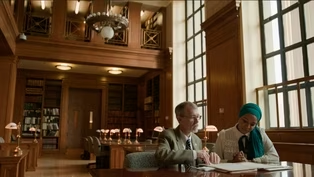
A Muslim in the Civil War Preview
Preview: Ep3 | 30s | A Civil War pension file reveals the story of a Muslim man who fought for the Union. (30s)
Providing Support for PBS.org
Learn Moreabout PBS online sponsorship












Support for PBS provided by: